

Review: The Story at the National Theatre
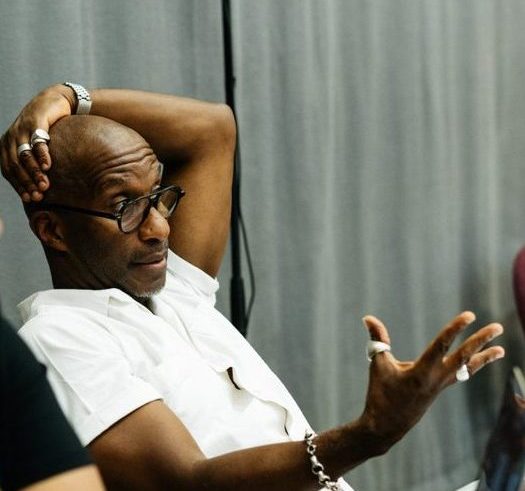
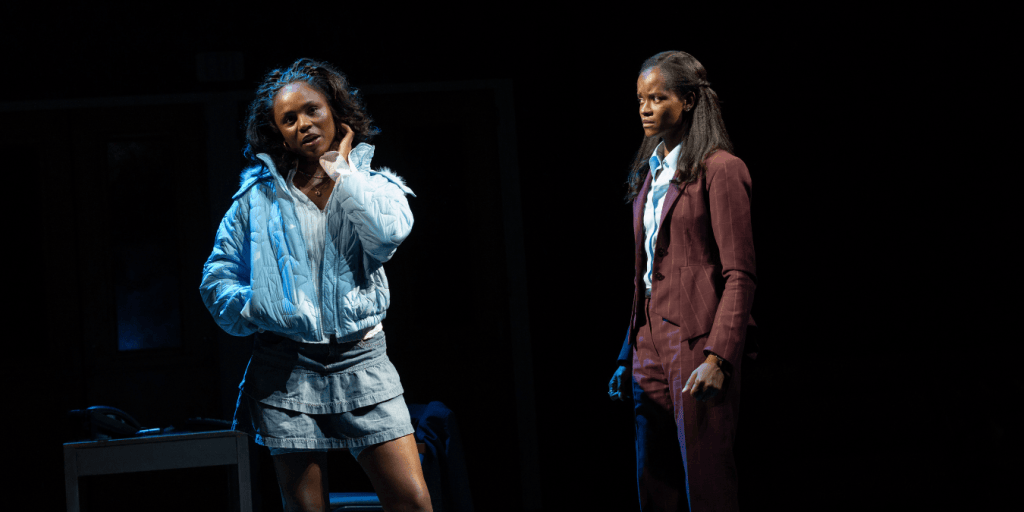
Clint Dyer’s direction of The Story delivers a gripping, intricately constructed drama in which the twists and shifting perspectives keep the audience questioning what they believe to be the truth. Written by Tracey Scott Wilson, the play explores race, media representation and the power to shape narratives, examining who gets to tell the stories of Black communities and the consequences when those stories are distorted.
The production unfolds with the pace and tension of a television drama, brought to life by a cast whose performances are matched by Dyer’s assured direction. Letitia Wright, as Yvonne, is a compelling presence, revealing both the strength and vulnerability at the heart of her character. Her performance is a reminder of the depth of her talent, while the wider ensemble navigates the play’s intricate structure with precision and conviction.
Dyer, Associate Artist of the National Theatre and its former Deputy Artistic Director, credits speak for themselves and include Othello and the Death of England trilogy, co-written with Roy Williams, as well as One Flew Over the Cuckoo’s Nest at the Old Vic.
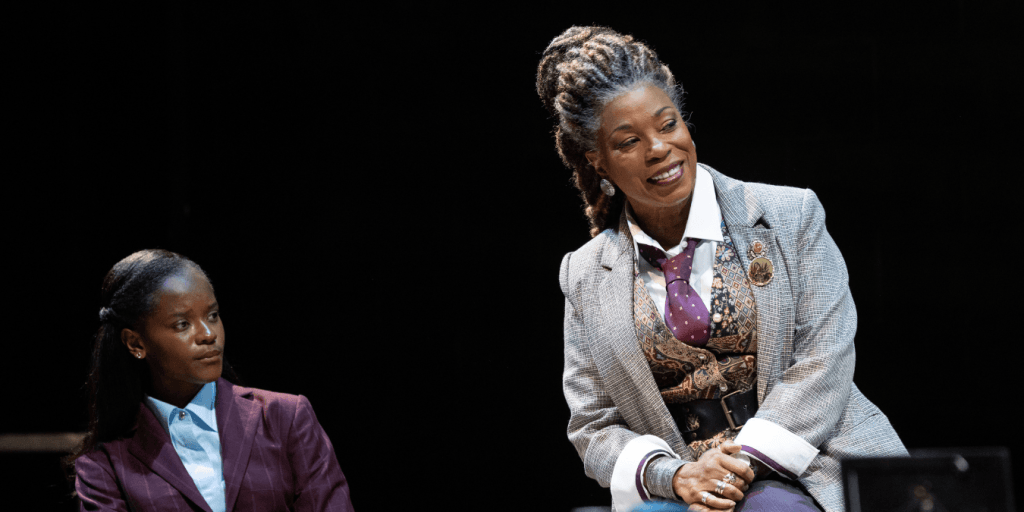
What makes The Story particularly effective is its refusal to settle into a single version of events. Just when the audience thinks it has worked out what the story is, another revelation shifts the ground beneath its feet. The result is an absorbing piece of theatre that challenges assumptions without dictating what the audience should think.
The interview
ALT: First, congratulations on directing The Story. I really enjoyed it. It was like watching a television series unfold on stage.
CLINT: Thank you.
ALT: Just a few quickfire questions. What invited or enticed you to think this was something you wanted to direct?
CLINT: The conversation that sits at the heart of it. I think there is a very powerful African American and wider Black diaspora story within it, about who gets to tell our story and the responsibility we have to be accurate. Sometimes that means putting information out there that is not necessarily positive for the Black community because of how it can be used against us. It is a fascinating conversation about the media and the Black experience.
The way we often have to shrink ourselves and our characteristics to fit a narrative that is spun about us. The way we have to metabolise false information about ourselves, and how ideas about culture become facts because somebody else says they are facts, when they are really just opinions. I find all those things important to put into the world and important to allow space for conversation, so that we understand that we are complex and different, and that our cultures are shaped by many, many internal and external influences. The idea that we are some kind of monolith needs to be dissected.
I am not even going to say challenged; I am going to say dissected, because I am in no way saying that I have an answer, that there is an answer, or that there is a right or wrong. I am not saying that at all. What I adore about the piece is that it really encourages the audience to make up its own mind about where and what the actual story is.
ALT: How closely did you stay to the original script by Tracey Scott Wilson?
CLINT: The original script was written 20-odd years ago, and Tracey rewrote it for this new production. Lots of it remains.
ALT: How did you feel when you were in the middle of producing The Story and suddenly found yourself in a situation that almost mirrored some of the things you were talking about? In real life, journalism has come under the microscope, raising questions about everything you have just mentioned. Could you talk about that a little?
CLINT: I suppose it is interesting in that more people are becoming aware of the power of the media and its capacity to be led down a path that, sometimes, I do not even think they want to go down, for the sake of trying to be current.
The idea of the whole truth is lost in the necessity to be first. Whether or not ill intent is at the heart of it, I do not know. What I do know is that it was reported on in a very different way from how Black people would have reported on it.
I suppose that is what is important about this story, about the play. It is a very Black conversation. A lot of the time, our conversations are in opposition to whiteness, and what is interesting about this piece is that the central tenet of it is Blackness, and both its protagonist and antagonist are Black. So it is not actually about who killed the white man, and that is quite controversial in terms of storytelling.
ALT: Definitely. What made you bring this combination of actors together, and what do you think Lorraine, Letitia and Ashley each bring to The Story?
CLINT: It was Ashley’s debut at the National, but he has been acting for a long time. I had seen his work before.
Funnily enough, he has done a lot of my work, and his accent is flawless. What I wanted was a clever African American who looked as though he knew his way around a cookout. I did not want somebody who simply thought he was a middle class African American, somebody generic who had gone to Harvard and fitted a particular mould.
We all know that type of person, but we do not usually see them portrayed in that way. I do not think we are always in control of our own work enough to allow for the eccentricities that such a character offers. On the one hand, people want that kind of character, but, as he says in the play, the constant code switching messes with his head.
What I wanted was somebody who had the ability to code switch and then decided, “I am not code switching any more. I am done with it, and this is me.” Someone who can outsmart anyone, hold a conversation with anybody and simply be themselves. That intrigued me about the character of Neil.
Letitia was my number one choice from the moment I read the script. I just thought, this is Letitia, this is Letitia. She has the ability to be very, very strong while also seeming completely fragile.
She is a wonderful export and a wonderful actress we have in our midst. She is obviously one of the stars of a generation, and it is important that someone like her plays Letitia.

As for Lorraine, I have been watching her for donkey’s years. I have been watching Lorraine for years and years. It was a real thrill that we could make it work and bring in somebody who has that authority straight away. The character needed to be played by somebody we felt was authentic to what she says. I wanted an American for that role because it gives a different frisson to how we, as British audiences, accept the work we are watching. It is not even just about how we value it, but how we receive it.
ALT: A little bit about you. You are here at the National Theatre directing The Story. Looking back at some of your earlier productions, are there moments when you look back in awe and think, “Wow, perhaps I never imagined this would happen”? And what have been some of your learning curves as a director working in this space?
CLINT: I suppose that, as Deputy Artistic Director, I obviously had a hand in the plays that were chosen and how they ended up on stage. You learn about the type of work that works on stage, and you learn how to stage something in a thousand seater.
You get used to the audiences and the type of work they respond to. You also lose the trepidation that comes with working on such a scale. It actually excites you rather than threatens you.
I suppose the interesting thing about all this is that, for me, it is not so much about learning. I think this is what I believe: for Black and brown artists, it is more about opportunity than saying, “I learned this, I learned that, and I learned something else.” Obviously, we learn through opportunity, but I think there is too much emphasis on the idea that we have to be the best, the most brilliant, the most successful, and so on.
The truth is that it is about opportunity, and we deserve opportunity. I am thankful for the opportunities I have had. As a theatre practitioner, I have had the capabilities I have now for a long, long time. I simply did not have the opportunities.
I think there are many genius directors, writers, designers and other creatives out there who are as good as the people working at the National, including myself. I just think it is about opportunity and whether you are lucky enough, fortunate enough, as I have been, to get that opportunity, even if it comes in your later years.
ALT: Would you go back to acting? Do you think you would ever swap back?
CLINT: I am still acting, of course I am still acting. There is no going back. I have always acted. It has only been time that has made it impossible for me to act.
I was acting for 30 years. There is no way I am not going to act. I am an actor. That is what I am.
I have been lucky enough to pick up a few jobs here and there that I have been able to fit into my schedule at the National. Now that I am an NT Associate Artist, I am back in the world of acting, writing and directing more fully again.
So I am back!
ALT: It is quite funny because the last thing I remember seeing you in was something I keep seeing in a trailer on YouTube. It goes back about 25 years, or perhaps to the 1980s. You were in a police cell, and you looked like a completely different person. I think that is potentially the only thing I can remember seeing you in, which is strange.
CLINT: I bet you have seen me in other things; you just have not realised it was me. That is probably what has happened.
I used to play a lot of different types of characters. I was not lucky enough to get roles playing myself. I always ended up playing somebody completely different from me.
Some people say that is a great thing. Others say it is tricky because people do not recognise you from one role to another. They ask, “What have I seen you in?” Then you tell them, and they say, “Was that you?” You have to say, “Yes, that was me.”
It is a fascinating thing.
ALT: How would you say the kinds of stories you want to tell have evolved over the years? Or do you think they have remained consistent in terms of the stories you want to tell and the scripts you choose to direct?
CLINT: I do not know. It is an impossible question to answer because, unfortunately, I do not own many theatres, and I do not own a television or film company. I am still in a position where somebody else has to say yes to me before I can do what I want.
There are at least six cupboards full of things I have not been able to do. People might be fascinated to discover that I had the idea to do those things but was not allowed to pursue them by the powers that be.
So it is impossible for me to say. Of course, you can see a thread running through my work, but it is still dependent on somebody else saying yes. I offer ideas, and they usually say yes to one of them, but it still depends on which idea gets taken forward.
My life has opened up a bit more, and I am being offered different kinds of things, but, again, whether they happen or not is another matter.
ALT: Is there anything in the pipeline that you can talk about?
CLINT: Not really. I know there is a project called Fella.
ALT: Are you directing that?
CLINT: No, I am developing quite a few things. There are a few projects I am hoping people abroad will follow through on, as they said they wanted to, so that we can make them happen.
I have also got a good few writing jobs from some brilliant places that I need to knuckle down and do. And I am back auditioning as normal. So watch this space.
ALT: A few quick questions. If you were speaking to my audience and encouraging them to come and see The Story, which ends on 24 October. Why should they come and see it?
CLINT: I would say, get your tickets quickly because once it is gone, it is gone. Everything speeds up towards the end because everybody starts to feel, “Oh no, I am going to miss it.”
So do not wait until the last two weeks. That is what I am saying. Do not wait until the last two weeks, thinking you will get a ticket, because it will sell out.
I am very proud of this production. I am very proud of what it means to our culture, and I am very proud of the performances and how we have managed to deliver something so complex. I have never read a play that is as difficult to perform and stage.

ALT: Can I just interject? I was going to ask you about that because the production is so intricate in its detail. The casting must have been one of the factors that made it work, alongside your vision as a director. I would love to hear a little more about that because it is tricky. There is one twist, then another story, and then another story.
CLINT: Yes, exactly. Getting a company to work at that level all the way through is a real challenge. By level, I mean the timing. There is a physicality and a rhythm working within the whole production. Even if you are bringing on a chair and miss your beat, you have messed up the entire scene.
There are sound cues coming in, and the number of sound cues is extraordinary. I do not know another show with as many sound cues, perhaps apart from a musical.
We have delivered something that is extraordinarily difficult to create and to deliver on a nightly basis. I do not know whether we will see anything quite like it again because it is a real undertaking, and you have to be willing to put yourself through it.
ALT: Finally, what do you do outside this public space? What do you enjoy doing that people might not know about?
CLINT: I box. I do a lot of boxing.
ALT: Oh, you do?
CLINT: Yes. I use it more as a way to exercise than to fight anybody.
I suppose my passion outside of here at the moment is boxing. I love the footwork, as well as the brains you need to avoid getting hit. There is so much value in that, and I find the speed of it very attractive. It is more the speed than the power that I find attractive.
ALT: Thank you so much for talking to us. I really appreciate it.
CLINT: Thank you
If you have the opportunity to see it, do not miss it. The show ends 24 October: https://www.nationaltheatre.org.uk/productions/the-story/
For more theatre news, share this interview and support independent journalism by donating to our fund.