

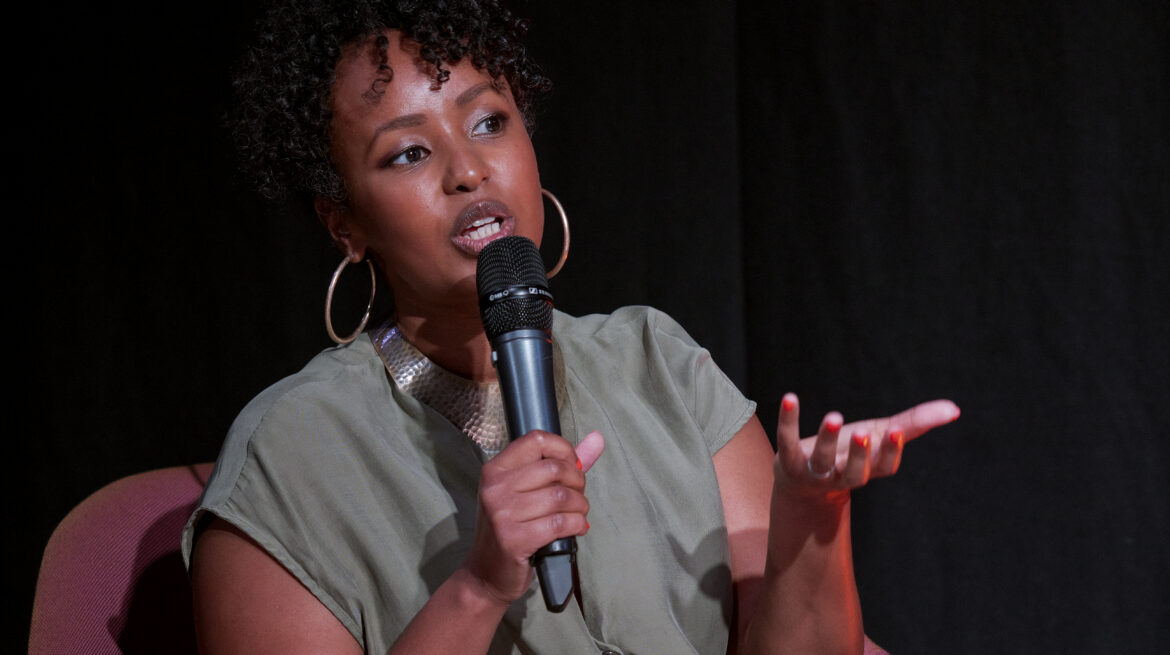
“So this is also about how Black women of a certain age stay well. How do we stay well? How do we take care of each other? Because that is still the case. In most of our communities, it will be Black women doing this work.” Fozia Ismail
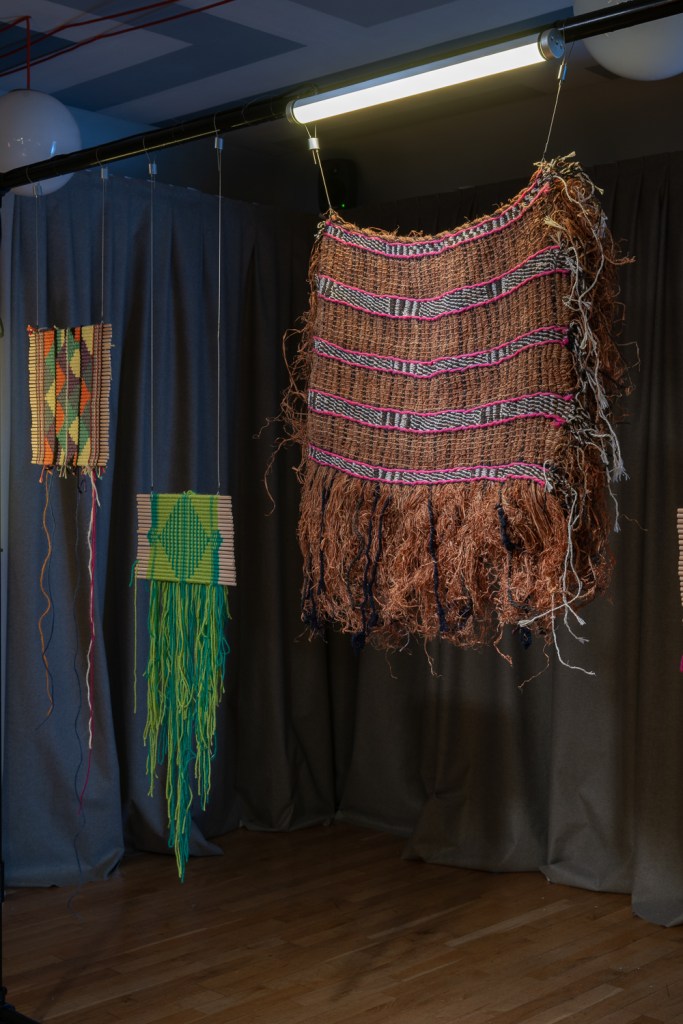
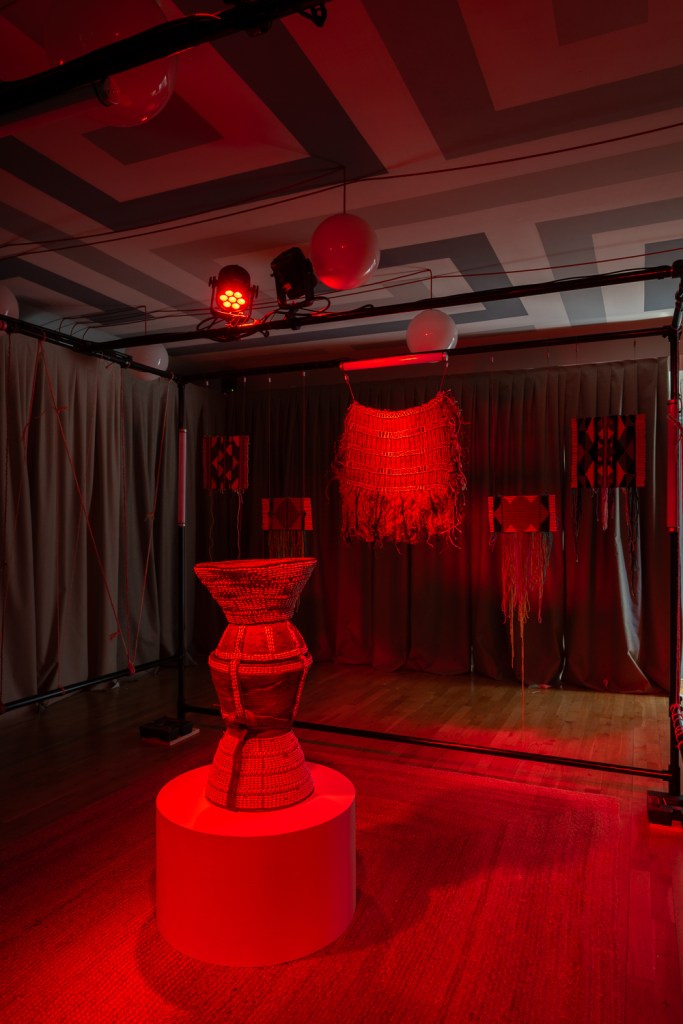
In this exclusive interview, British Somali artist Fozia Ismail explores the rich cultural legacy behind the Xeedho (also known as the Eedo) wedding basket and the inspiration behind her latest exhibition. Drawing on conversations with Somali elders, archival sound recordings and creative technology, she reveals how memory, women’s knowledge and ancestral traditions have shaped the installation. From weaving and storytelling to climate change and cultural preservation, Ismail reflects on safeguarding the living heritage of Somali nomadic communities and ensuring these traditions continue to inspire future generations. Presented at Whitechapel Gallery for Backyard Biennial: East, Fozia Ismail’s ‘A Song for the Xeedho – The Knot Makers’ is an interactive sound installation of rope, knots and weavings centred on the endangered Somali wedding basket. Free today at the Whitechapel Gallery Ismail is in conversation with Precious Adesina: book here
ALT: Fozia Ismail, thank you so much for talking to ALT A Review in advance. What first drew you to the story of the Xeedho wedding basket?
Fozia: Yeah, I mean, for me, I think what was interesting is that I’ve been working with Somali elders for years. My mum actually gave me one of these baskets five or six years ago because I was doing research on plant materials and the way in which Somali nomadic people used plants, and how some of those materials are changing.
When I was looking through that research, I came across an article about the UN and this wedding basket becoming endangered. It’s considered red, and it’s on the critical list for the UN Intangible Cultural Heritage. So I was really interested in doing a bit of work around that.
That’s what led to it, because I grew up seeing these baskets. My mum is a nomad, so we’ve got a few of them actually, and my mum lends them out. She’s part of a group of elder women who have kept the tradition going. The same thing happens in Bristol, where I work with a group of elder women. My mum loans hers out, and there’s a woman there who does the same. So I guess I was thinking about what happens to these things when a certain age group passes on, and what’s going to be left behind. That’s what started me on this journey.
ALT: I think you kind of touched on it already, but why is preserving the Edo important to you, especially today?
I think it really represents a very important aspect of Somali culture. It’s kind of a container for Somali nomadic culture, as I see it.
The basket itself is the main object, and then you have this part called the fichan, which is the wedding bowl. It’s now a metal object, but it used to be a gourd. Inside the basket is camel meat and date paste, and I work with food a lot as well in my practice. I also have a real reverence for camels, which you can see through dhaqan collective, A lot of the Somali nomadic themes that were a key part of my previous collaborative projects came from this knowledge about relationships and the importance of being able to make things with your hands.
JOIN THE FREE ARTS AND CULTURE NEWS LETTER The Cultra e-Diary HERE
The environment is scarce and quite harsh, and from that harshness comes so much beauty, with beautiful objects created from very limited resources. I feel fortunate that I come from a family that passed that on. When I was 18, before going to uni, I stayed with my aunt, who is a nomad. I saw nomadic life and stayed in an aqal. So, I guess it’s always been there in the back of my mind.
Also, younger Somalis don’t know about these traditions. I assumed that because I’m Somali nomad, everyone would know some of this stuff, but not really. So that’s part of the reason it’s so important, and it’s great that it’s at Whitechapel because that area is full of Somali people.
I’m really excited for young people to come in and see the exhibition and the installation as well, because I use creative technology to bring out some of this storytelling.
ALT: Talking about that creative technology, how does sound help bring the history to life?
Fozia: The sound is such an important part of the way Somali people pass on culture.
Songs are such an important part of advice, of how you make things, of educating you about plants, trees, and camels. There’s this wonderful interdependence with the natural environment that they rely on, and it comes out in songs and poetry. So sound is a really key part of the practice. I always work in sound, partly because Somali culture is so oral.
It’s also a literacy issue. My mum can’t read and write, and actually a lot of women of her generation weren’t taught to read and write, which is really awful. But what comes out of that are ingenious ways of keeping communication and education going through other means.
In terms of knowledge production, I’ve always been interested in the way Western culture is obsessed with literacy as the only legitimate form of knowledge. But memory, gatherings, and storytelling are also forms of inherited knowledge that get passed down this way. The thing is, it’s ephemeral. You can’t see it. You have to be in the room, or you have to be part of it.
I’ve always been interested in that. For me, my mum is one of the smartest people I know. But people can easily write off a certain type of Indigenous African woman who doesn’t fit a Western sense of what knowledge or intelligence is. That’s why I love working in sound, because it’s much more inclusive in a way. Anyone can engage with the installation.
ALT: And what can knots and weaving teach us about memory?
Fozia:
I think part of this journey has been being reminded of stories as well, like an amazing book by Maxine Hong Kingston called *The Woman Warrior*, which I studied for my GCSE and A-level literature. I kept coming back to it.
Her last chapter is called “A Song for a Barbarian Reed Pipe,” and it contains so many complicated stories. She tells the story of an outlaw knot maker. It’s a mythical story: there was a knot maker who made such an amazing knot that it was outlawed because it made him blind, because it was so difficult to unravel.
She thinks of herself as an outlaw knot maker, with fragmented stories and fragmented memories. The knot becomes almost the way diasporic communities, or the way I feel, memory can be fragmented at times around the stories we tell ourselves when we’ve been displaced or moved.
This book really highlights the things your family doesn’t tell you, or doesn’t reveal, because of trauma, and the things they are willing to reveal. It comes from her perspective as a child. I feel like that’s really resonant with this work, because the wedding ropes I’m making, and also an article I wrote a few years ago for Shado magazine, connect to a distinct memory I had when I was in Somaliland.
It was me, my mum, and my aunt making this wedding rope for my sister’s wedding. But my mum, through this project, said, “It wasn’t for your sister’s wedding. Your sister got married in 1996, and you were there in 1998.” So it was for someone else. But in my head, for 25 or 30 years, I thought, “Oh, we’re making the wedding rope for Zahra, who’s getting married.”
That’s the way memory works. You make things in your head that fit, especially if you’re from a refugee background, especially if you’ve migrated, especially if your mum is settling, and you only really learn as an adult the sacrifices these women have made.
The knot is really important to the wedding basket because there’s a whole ritual around the ceremony. A skilled knot maker does it, so there’s a skilled woman who knots these things, and it can take up to three days to unknot. During the ceremony there’s singing, and if the women’s family catches the groom’s family getting the knot wrong, they have to do a performance, either a poem or a riddle.
So it becomes a really performative thing. The knot becomes important, and you can’t cheat and use a knife, otherwise the ceremony is called off. I find that really interesting, this game that is part of the wedding ceremony but is also practical. It’s almost like, if this person cannot knot or unknot, how practical will he be in the wilderness? It’s also a test of social intelligence: is he witty, can he make you laugh, and so on.
I find the whole ceremony aspect interesting. I didn’t have one. My sister went through the traditional ceremony and didn’t like it because she thinks it’s sexist and outdated, and the basket represents a woman. So for her, it feels a bit outdated.
I didn’t have it, so I can see that perspective. It could absolutely be seen as an outdated practice. But I also think it’s really about the making of the basket and what women do to gather and make this important thing. They are basically the containers of knowledge in Somali culture, so I’m always in awe of Somali elder women. It’s kind of a love letter to their skill set and what they’ve done to keep our culture preserved, even while being uprooted all over the world.
ALT: I was actually going to ask you the next question, and I think you’ve kind of touched on it already: what does it reveal about collective knowledge and survival?
This gathering, this way that women would gather, is really beautiful. I’ve learned a lot from sitting with elders. I feel like they aren’t rooted in capitalism in the same way.
Maybe it’s because I’m feeling a bit lost with where the world is going. There’s also a lack of understanding for these women, and I’m really interested in the interior lives of Somali elder women, who have long been invisible and whose skill sets are not recognised.
Sometimes this is about looking at the knot as a complication between mothers and daughters. If your mum came here, you know, I can say I’m British Somali. I’m not Somali-Somali in the same way she is, because she grew up there; she’s of that land.
The relationship between mothers and daughters is not straightforward. The obligations are complicated, especially in Africa. It’s a very common thing for African people to send money back home. That’s common across the African diaspora.
What I’m interested in is whether my sons will do that. I send money back home, but will my children do that? So this gathering is also about, to a certain extent, obligation: what are you doing for people back home? It’s a reminder that there are people back home suffering because of colonialism, because of the way the world is set up, and we were the lucky ones who should be grateful for being here.
But what does that mean in a time when Britain is highly racist and oppressive toward Black and Muslim people and others? I’m also referencing another book by Toni Cade Bambara called ‘The Salt Eaters’. It’s a really beautiful work about an activist, a Black woman who has a breakdown at the beginning of the book. Toni Cade Bambara is looking at what the implications are for Black women’s mental health.
What are all of these invisible labours of organising, gathering, and feeding the community? Even during the civil rights movement, what you hear about is Martin Luther King and Malcolm X and these men. What people don’t see is all the women who were organising, all the women who were doing the work. Even with textiles, you had the Gee’s Bend quilters, who would sell their quilts to get people out of prison as part of the civil rights movement.

All of this women’s labour, Black women’s labour, went into organising freedom. I think of that in a similar way with Somali women. Somali elders and Somali women throughout the civil war and throughout displacement are the ones who gather and keep the community safe, regardless of what’s going on.
So this is also about how Black women of a certain age stay well. How do we stay well? How do we take care of each other? Because that is still the case. In most of our communities, it will be Black women doing this work.
She opens the book with a really quick, amazing line: “So, are you sure, sweetheart, that you want to be well?”
It’s an older Black woman trying to help a younger Black woman. A lot of being well is about connecting to our ancestral ways of being well, and making, and being. I think it’s very difficult to be well within a Western framework that doesn’t understand these nuances in your own cultural background.
ALT: What do you hope visitors will feel when they enter the space?
I really hope they feel welcomed, to be honest. I want them to feel that, for all the heavy themes, it’s actually a really celebratory soundscape because it’s weddings. There’s a real joyfulness there because I also see joy as a really important part of Black African resistance to colonialism.
I hope they sit with the music. I hope there are moments in the soundscape where people reflect. It’s also interactive, so when you touch these wedding ropes, different sound and light come across. I really hope people feel that they’re part of the wedding performance, almost as an audience.
You are an active member of it, in the sense that I’m bringing in the playfulness of the wedding ceremony by enabling people to touch a wedding rope and see some change in the environment around them because of their interaction. I’m really excited for that element of magic that comes across through the technology.
I’ve got copper wiring around these wedding ropes that connect to a little tech board that a computer designer created for this structure. That allows the interactive aliveness of the installation to come through.
ALT: Two really short questions. Where do you call home?
I’ve been struggling with this, to be honest. I’ve been really struggling with this recently.
I live in Bristol, and I’ve been in Bristol for 12 years. If I’m honest, I would say London is still my home. I love London. I grew up in Brent, in Stonebridge Estate near Harlesden.
London is really special. If you’re not white, I genuinely think London is probably the city that feels most like home. I grew up there, but you’re also freer there. I don’t know how to describe it. It’s a great city in that way. So I’d say London.
ALT: After doing an exhibition or some work, what would you say is your go-to food?
Fozia: I’m going to a Somali restaurant.”

There’s an amazing place called Hayber in Shepherd’s Bush, near Shepherd’s Bush Market. I’d say it’s H-A-Y-B-E-R. It’s amazing. It’s really, really good. It’s not fancy, but it’s the best Somali food in London, in my opinion.
There’s another place in Whitechapel I haven’t tried yet, so I need to start trying the Whitechapel places because my family is in West London, so I tend to go to Shepherd’s Bush for food. I’m looking forward to, during the installation, going to try some of the good spots in Whitechapel as well.
ALT: Fozia, thank you so much for talking to ALT A Review. I really appreciate it.
Like this work share to a friend, follow us on Instagram