


Presented at Whitechapel Gallery for Backyard Biennial: East, Fozia Ismail’s ‘A Song for the Xeedho – The Knot Makers’ is an interactive sound installation of rope, knots and weavings centred on the endangered Somali wedding basket. The Xeedho becomes a container for exploring how human and non-human knowledge, memory and survival are transmitted collectively between Somali nomadic women across rural and urban landscapes. ‘A Song for the Xeedho – The Knot Makers’ is co-commissioned by Whitechapel Gallery with Counterpoints Arts for Backyard Biennial: East. ‘A Song for the Xeedho – The Knot Makers’ is supported by Whitechapel Gallery and Arts Council England.
A Song for the Xeedho – The Knot Makers‘ begins with a lost photograph taken in Somaliland in 1998 of the artist’s mother, aunt and another woman sitting against a bright blue wall, twisting plant fibres into wedding rope, their hands moving like magic. That lost image becomes the animating absence at the heart of this exhibition, “It felt like watching a kind of magic, women transforming plants from the land into something strong enough to hold a house and a whole culture together,” says Fozia Ismail.
Bringing together rope, knots, woven forms and sculptural interpretations of Somali nomadic objects with sound, Ismail explores women’s labour, migration, climate grief and the collective knowledge systems that persist despite them.
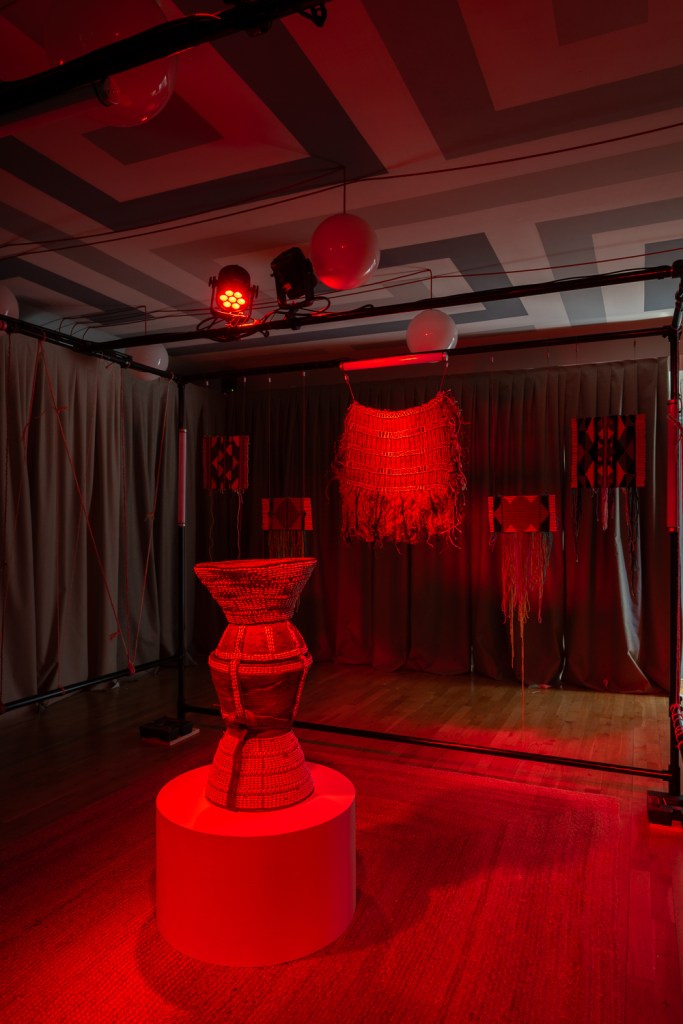
At the centre of the work is the Xeedho (pronounced as Hey-ro), the ceremonial basket prepared by a mother-in-law for her son-in-law during the first week of a daughter’s marriage. A layered ritual object of preserved camel meat, ghee, spices, leather and shells, the Xeedho is bound with ropes intentionally hidden within its structure. The untying of those ropes forms part of the ceremony itself, accompanied by riddles, poetry and playful exchange. The knot here is not simply a fastening; it is a test of social intelligence, a form of knowledge passed not through formal instruction but through observation, shared labour and embodied practice.
The soundscape, activated through touching the ropes, is a collage of Somali folk songs sourced from The Centro Studi Somali (Centre of Studies on Somalia) at Roma Tre University. Live recordings made by Fozia Ismail with Somali Nomadic Elders, including her family, are woven into the soundscape.
Drawing on feminist literary references like Maxine Hong Kingston’s The Woman Warrior and Toni Cade Bambara’s The Salt Eaters, Ismail uses the knot as a metaphor for the complex, non-linear and otherworldly stories we construct about memory, identity, spirituality between communities of women dealing with multiple layers of discrimination. Ismail’s work does not attempt to resolve the gaps between stories, between histories fragmented or implied. Instead, she holds them in tension, much as a knot holds many strands without resolving their contradictions. What does it mean to be well in this context of crisis?
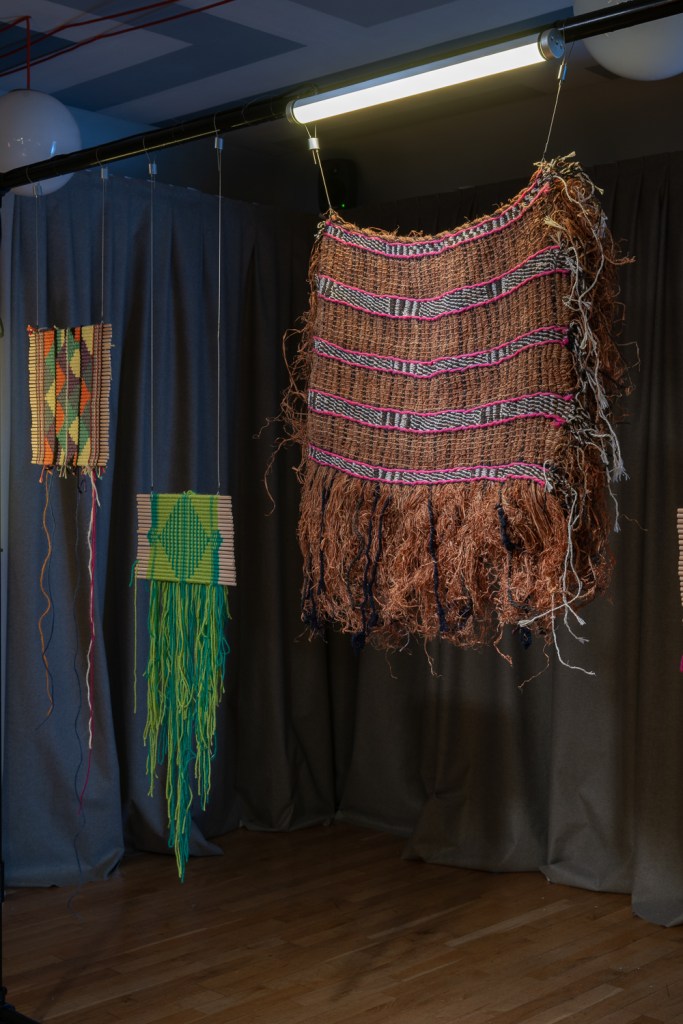
The installation confronts the urgent ecological crisis. The plants used to make wedding rope, the seasonal rhythms that structured nomadic life, and the songs sung during collective making are all bound to landscapes being devastated by continuous drought and climate breakdown.
Fozia Ismail says: “As forced migration severs communities from the land, the knowledge encoded in these practices, which plants to gather, which knots to tie, which songs to sing, begins to disappear with it. The wedding basket, once an everyday object of nomadic life, is becoming an artefact. What is lost is not only the craft skills but an entire ecosystem of knowledge about our relationship with plants and animals that form a key part of the Xeedho. One thing that gives me hope is that despite climate collapse, the gatherings around the Xeedho still happen, although the materials may not be the same. The Damal or Galool tree bark that was used to make the wedding rope is no longer available, but nomadic women have adapted by reusing food sacks (usually made of plastic) rope.”
Working across sculpture, installation and sound, incorporating interviews with Somali women elders and archival recordings, Ismail centres the interior lives of nomadic women and their forms of collective, intergenerational pedagogy. Her work resists frameworks that treat these traditions as either exotic or endangered heritage, insisting instead on their vitality as living acts of resistance “against discrimination of Somalis, Islamophobia, and the violent logic of extractive capitalism.”
Fozia Ismail says: “In making ‘A Song for the Xeedho – The Knot Makers’ I am asking what it means to understand art as something that emerges not from individual authorship, but from women sitting together, weaving, knotting, cooking and preparing for life’s ceremonies and creating objects that are both aesthetically beautiful and healing. And in a time of ecological breakdown and displacement, I want to invite people to think more expansively about how we might hold onto culture in the broadest sense of the word (plant, animal, human), not as something fixed but, as one elder described it, as a living companion.”
‘A Song for the Xeedho – The Knot Makers’ will be shown at the Whitechapel Gallery during Backyard Biennial: East from 15 July to 6 September. For more information, visit www.whitechapelgallery.org/exhibitions/backyard-biennial
Backyard Biennial: East
Dates: 15 July – 6 September 2026
Venue: Whitechapel Gallery, 77 – 82 Whitechapel High Street, London E1 7QX
Admission: Free
Website www.whitechapelgallery.org/exhibitions/backyard-biennial-east
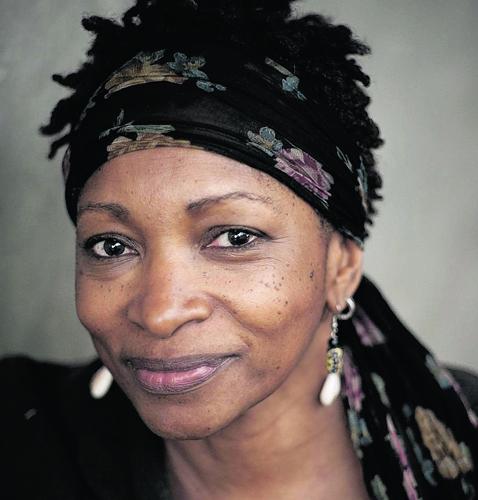
Fozia Ismail (b.1980, Kuwait City, Kuwait) is a British Somali artist, founder of Arawelo Eats, and co-founder of dhaqan collective. Her practice moves across food, sound, textiles and found objects to create material-led works exploring migration, climate, identity and diasporic memory.
Rooted in Somali nomadic feminist pedagogy, her work approaches everyday cultural practices as living archives of care, knowledge and survival. Through collective acts of listening, eating, weaving and making, she reframes domestic and communal space as sites of shared authorship and cultural continuity. Central to her practice are inherited materials and objects connected to her mother’s Somali nomadic roots – vessels, spices, textiles, cassette tapes and sound recordings, which she activates through collective gatherings and transforms into sculptural, time-based and archival works.
Her project Camel Meat & Tapes marked a significant shift towards a participatory practice grounded in Somali oral traditions and communal forms of knowledge-making.
With dhaqan collective, Ismail has exhibited internationally at the British Textile Biennial, Southbank Centre, Biennale Architettura Venice, Weltmuseum Wien, Playable Cities, Osaka and Jodhpur Art Week, with support from the British Council and Arts Council England.
Her ongoing research continues to explore inherited material culture, social practice and Somali feminist ways of knowing, making and remembering. Ismail is a resident of the Pervasive Media Studio and has a studio at Spike Island, Bristol.
Backyard Biennial: East is an 8-week, free summer arts festival initiated by Whitechapel Gallery in collaboration with over 40 local partners and collaborators across East London.
Titled East and featuring exhibitions, installations, screenings, performances, workshops, residencies, walks, open studios and special events, this first iteration of Backyard Biennial will celebrate the unique historic, cultural and creative identity of the East End, and pay tribute to its many diverse communities and industries.
One of the youngest, most ethnically diverse, and fastest growing areas in the UK, East London has a long and rich history of political and social reform and continues to be a powerful site of renewal and resistance. A global benchmark of creative innovation, it is home to many artists, writers, poets, musicians, philosophers and activists. It is also an established centre of artisan craftmaking, notably supporting local textile and furniture industries, breweries and housing the historic Whitechapel Bell Foundry.
A flagship of Whitechapel Gallery’s 125th anniversary year, this innovative pilot project is designed to reframe what an arts biennial is and who it is for. It proposes a vibrant and evolving model for community participation and audience engagement, continuing the Gallery’s commitment to working with local stakeholders to create sustainable cultural and social infrastructures.
Over a series of ‘gatherings’ convened by Whitechapel Gallery, partners worked collaboratively to inform a community-driven and inclusive framework for the Biennial. The process is being supported by Kin Structures, an artist-led organisation dedicated to enabling collective agency and sustainable infrastructures.
The Biennial will take place across a range of local venues, including art galleries, cultural and grassroots organisations, educational centres, places of worship and other public arenas. The programme will embrace East London’s past, present and future: from stories of migration and journeying, ecology and land-use to walking practices, music and song and community archives and utopian imaginings. Audiences will be offered new ways to encounter works – both within and beyond traditional gallery spaces – while also exploring the East End through diverse perspectives.
Participating organisations include: Acme, Alvaro Barrington’s Studio, Artsadmin, Auto Italia, Bevis Marks Synagogue Heritage Foundation, Bow Arts, Centre for the Sciences of Place and Memory, University of Stirling, Counterpoints Arts, Emalin, Four Corners, Greatorex, House of Annetta, Jewish Museum London, Kin Structures, London Community Video Archive, London Metropolitan University, London Parks & Gardens, Migration Museum, Mile End Community Project, NıCOLETTı, OITIJ-JO Collective, Oxford House, Public Gallery, Queen Mary University of London, Raven Row, Save Soanes, SLQS Gallery, The Somali Museum, Spitalfields City Farm, Spitalfields Life, St Margaret’s House, Swaraj Music, The Gilbert + George Centre, Tower of London (Historic Royal Palaces), Trapped in Zone One, Underground East, University of London – Centre of Public Engagement Practice for Arts and Humanities and the vacuum cleaner.
About Whitechapel Gallery
2026 marks Whitechapel Gallery’s 125th Anniversary, providing a unique opportunity to celebrate the Gallery’s groundbreaking history and set a bold agenda for the future.
Founded in 1901 with the aim to bring ‘the finest art of the world to the people of East London’ the Gallery has been responsible for bringing some of the most radical, innovative and influential artists of our times to its East End home. From the outset it pushed the boundaries of what a locally embedded cultural institution could do: giving voice and platform to local, national and international artists at all stages of their careers; presenting diverse practices, forms and ideas; exemplifying sector-leading learning and community outreach programmes; and being at the forefront of the global cultural scene.
From ground-breaking solo shows from artists as diverse as Barbara Hepworth (1954), Jackson Pollock (1958), Helio Oiticica (1969), Gilbert & George (1971), Eva Hesse (1979), Frida Kahlo (1982), Sonia Boyce DBE RA (1988), Sophie Calle (2010), Zarina Bhimji (2012), Emily Jacir (2015), William Kentridge (2016), Theaster Gates (2021), Nicole Eisenman (2023), Zineb Sedira (2024), Gavin Jantjes (2024), Peter Kennard (2024), Lygia Clark (2024), Sonia Boyce (2024), Donald Rodney (2025), Hamad Butt (2025) and Joy Gregory (2025) to thought-provoking group and thematic exhibitions that reflect key artistic and cultural concerns, the Gallery’s focus on bringing artists, ideas, and audiences together remains as important today as it did over a century ago, and has helped to cement the East End as one of the world’s most exciting and diverse cultural quarters.
The programme for our anniversary year continues to give space to a range of perspectives from the local to the global, with priority given to those systemically under-represented, especially women-identifying artists and artists of colour. Our mission is to ensure that Whitechapel Gallery continues to claim a distinctive and radical position in the wider social and cultural landscape, building on its pioneering history while translating and animating it for our time