

Immersive and dreamlike, Juliet Ellis’ new work A Symphony of Flesh and Bones offers a profound meditation on the fragility of the body, the construction of identity, and the impermanence of human life. Presented as part of MIF2025, the piece runs from 10–13 July at South Warehouse, Aviva Studios, and blends live performance with a multi-screen film installation. Ellis, an award-winning interdisciplinary artist, sits at the heart of the work — conducting the space while confronting the realities of aging, masculinity, memory, and selfhood through the lens of her father and brother’s bodies.
ALT sat down with Juliet to talk about the inspiration behind the piece, the personal and spiritual journey that shaped it, and why making space for working-class Black British men in art is a powerful act of legacy and love.
ALT: Your new work, A Symphony of Flesh and Bones, blends film, performance, and installation. What was the starting point for this deeply personal piece?
JE: I would say that the work is arising out of my Buddhist meditation practice. Questions about the nature of reality — what is self, are we our body, what is the self — these questions work best when my brother and father are the starting points. Both have spent their lives constructing a body that they identify themselves as, and I wanted to take that as a starting point for the deconstruction of body, self, and mind.
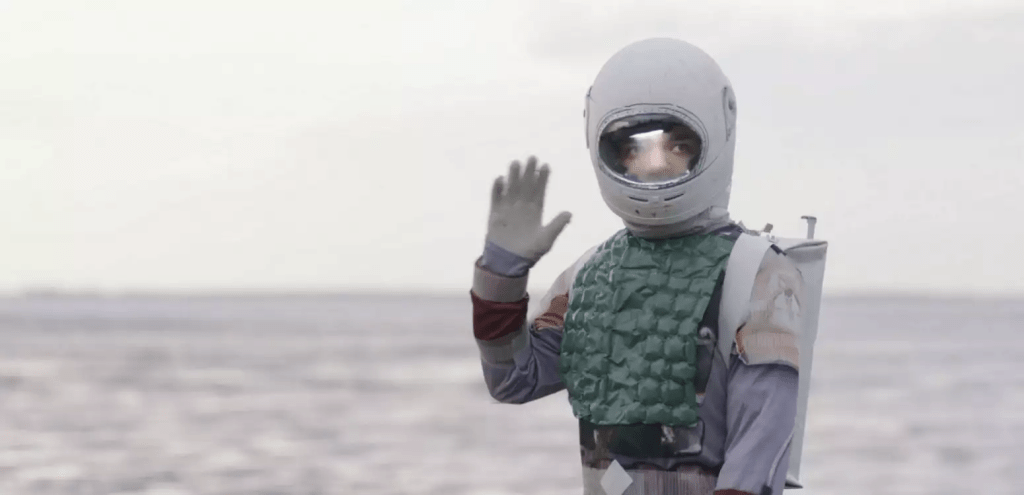
ALT: The work explores the fragility of the body, identity, and aging. Why were these themes important for you to explore at this moment in your life and creative journey?
JE: I don’t see myself as having a career; I have a creative journey, and now at this point it’s being married with my spiritual life. There has been an over-identification with the body as self, so naturally, there is a lot of anxiety around aging. The work explores what is self? It’s a great question to contemplate. What part of our identity is self… a great question to explore.
ALT: You’ve chosen to work with your own father and brother in the piece. What was that process like — emotionally and artistically?
JE: It was complex working with them. It’s hard to sometimes split those relationships when making the work — looking after them and feeling responsible, yet trying to get what you need from them to make it all work. They really inspire me. I love the fact that both of them can’t lie in front of the camera or anywhere else. They are just so authentic that you really get a sense of them being a mirror to our own internal landscape. A dear friend of mine, when I showed her some of the images, especially of my father, she said, “His face and body holds the stories of a thousand Black men.” I thought that was so beautiful. Hopefully, people resonate and see my father as holding the story of all people.
ALT: You have a strong background in both visual and performance art. How did you approach fusing those disciplines in this project?
JE: To be honest, I never think about the fusing. It’s so natural for me just to use all the aspects of my experiences. The work tells you what it needs. I just have to listen. This is what the piece wanted and needed, and I facilitated that with the language which is natural for me to use. I’ve always been a person who mixes things up — a collagist…
ALT: Memory and masculinity are core elements in the work. How do you hope audiences will reflect on these concepts through the lens of your family story?
JE: Masculinity in so far as these are the expectations placed on male bodies — especially Black males. I asked my brother if he felt that other people put him in a box or did he do that to himself, placed himself inside it. And he said, “I think I put myself in a box so that other people would be able to recognize me, but actually by putting myself in a box I don’t recognize myself. So who do people really know?” That was a powerful answer. Are we just all performing an idea of self? I would say that is some of the core elements I am dealing with. With memory — it’s a part of mind, so yes, I explore that in relation to the self, but I would say I’m more interested in the idea of how memories serve to reinforce this idea of self. That can limit it or empower it through memories.
:quality(60)/https://publicydn4hdgozyjrg.blob.core.windows.net/public/dd/images/ASOFAB_Crops_Website.ae928f7.jpg)
ALT: Can you talk about the sound and visual design — how did you use these elements to heighten the emotional atmosphere of the piece?
JE: I have a great group of creatives. Without them, none of this would exist. So a big shout out to them. When it comes to the environment — that came to me in a dream. Eight screens, inspired in shape by a mandala — geometric design that symbolizes interconnectedness of all things — and in meditation, we offer up a world in which we envision no suffering. That became super meaningful. I call it a cinematic mandala. It also feels like it’s transcendental, not solid, like the mandalas the Tibetan monks make. It shouldn’t feel permanent — just existing for a moment, then gone. And the colour blue, which is an important aspect in Buddhism, represents the vastness of the sky and oceans, representing infinity and the boundless nature of reality. There’s a line in the piece where I say, “I sky-coloured their bodies.” And that’s what I want for my brother and father — and everyone — for us all to tap into the infinite potential that resides in our own mind. I’ve worked with an amazing sound person, Guillaume — omg — a master of binaural sound and surround sound… I just said to him, he’s created sound that you don’t hear but feel. It’s an experience of the whole body. I can’t wait for people to experience that.

ALT: You describe the piece as meditative and immersive. What kind of emotional or sensory journey do you hope to take the audience on?
JE: For me, it’s simple — to investigate the nature of our own reality. What is the body, self, and mind? What is mind, and what is it capable of doing? We all have the inner potential — be curious about that. What would that mean in your own life if you tapped into that?
ALT: As a Black British artist, do you feel this work speaks to wider cultural conversations around generational trauma, care, and legacy?
JE: It’s a great question. I have to say, the documentation of my father and brother will be something people can see for years to come. My father’s life wasn’t documented in his early life — no photographs, as I know, exist from age 0–18. I actually say that line in the piece. So now I have documented him and my brother. Two beautiful working-class men will take up space — in an art context. Depicting trauma isn’t something that I put in my work. It becomes an easy narrative for us to be associated with. I know it has entered the lives of the people I am depicting, but I want to recontextualize it all by exploring the hidden dimensions of a person’s being. For example, we have limitless potential that resides within our mind. The actual nature of our mind is peace. I can identify as that person who has a limitless capacity to love all beings — to have universal compassion and wisdom.
ALT: What’s next for A Symphony of Flesh and Bones — how does it feel to be part of MIF2025?
JE: It’s incredibly meaningful to be back in Manchester — a place I lived for over 10 years. There’s a strange sense of a ghost self, a residue of it permeating as I walked around the streets of Manchester. I live in New York now and split my time between there and the UK. I know that being from a working-class background and trying to make work is getting harder. I hope my presence here will inspire people like me to make work. Just make it. Big or small. Be creative. Be joyful and generous with the work. Don’t ever be afraid of failure — it’s an artist’s best friend. The work will play in NYC next year. I hope to create a book of photography from the amazing images and also get the work in galleries as a film installation.
🗓️ 10–13 July 2025
📍 South Warehouse, Aviva Studios, Water Street, Manchester, M3 4JQ
🎟️ Standard £24 | Concessions £12 | Aviva £10 Tickets
➕ £1.50 booking fee | General admission, seating in the round
🔞 Age 14+ (under 16s must be accompanied) | Running time approx. 75 minutes
♿ Accessibility: Captioning, Wheelchair Access, BSL Interpreting
🌐 More info & tickets: factoryinternational.org
#ASymphonyOfFleshAndBones #JulietEllis #MIF2025 #FactoryInternationa#ImmersiveArt #MeditationAndArt #ManchesterArts