



Should Actors Be Worried About Tilly Norwood?
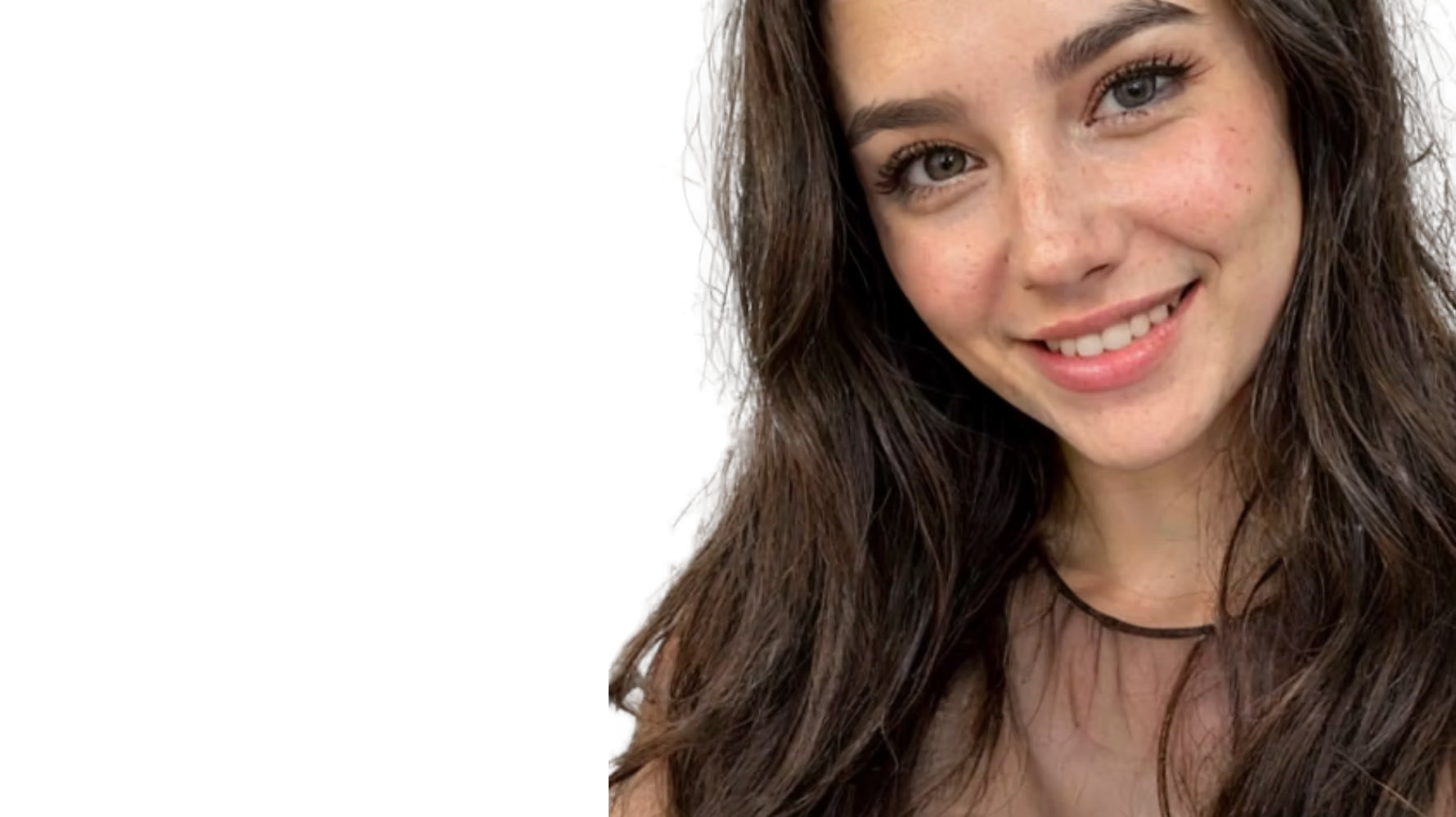
The global film industry has been buzzing about Tilly Norwood, a computer-generated actress designed by UK production company Particle6 and tech firm Xicoia. She is being positioned as the “world’s first AI film star” and will make her debut at the Zurich Film Festival. Her arrival has prompted excitement in some corners of the industry but also sparked real anxiety among professional actors. Tilly’s creator Eline van der Velden said the idea is not to take jobs from actors. Over the weekend it was announced Tilly is being head hunted by casting directors, and there is supposedly more to come from studios that are secreting using AI.
Tilly has been designed using advanced AI models to look, speak, and even emote like a human performer. According to a report in Broadcast, her creators imagine her as a new kind of star—someone who can appear in films, television, or advertising campaigns without the usual limits of casting, scheduling, or even aging. Early promotional clips show her laughing, crying, and delivering dialogue, all without a human actor on set.
Why Actors Are Concerned
Not everyone sees this as harmless innovation. Reactions from performers suggest deep unease:
In coverage by the Financial Express, actress Melissa Barrera described the development as “gross,” saying she hoped agents who sign AI talent would be dropped by their clients.
Former child star Mara Wilson questioned in the same article why producers would not simply hire one of the many real women whose images may have been blended to generate Tilly’s face.
Actress Lucy Hale reportedly responded with a blunt “No,” when asked what she thought of the project.
It isn’t only individual actors who are speaking out. The UK actors’ union Equity has been vocal about the risks of AI replacing human performers. According to the BBC, Equity’s “Stop AI Stealing the Show” campaign highlights concerns over the replication of actors’ likenesses and voices without permission or fair pay.
The Wider Debate
Industry voices point to three main areas of risk:
Ownership and consent – Who controls an actor’s digital likeness, and how can performers be sure their image or voice won’t be reused without approval?
Employment – If AI performers become cheaper and easier to use, there may be fewer opportunities for real actors, especially in smaller or supporting roles.
Artistic integrity – Acting is not just appearance; it relies on lived experience, emotional depth, and interpretation. Critics argue no algorithm can fully replicate that human quality.
At the same time, others suggest AI performers might not necessarily replace actors but instead expand creative possibilities. In an interview with Broadcast, Tilly’s creator Eline van der Velden said the idea is not to take jobs from actors but to explore what stories can be told when a “virtual star” can be endlessly adapted or placed into different settings.
How Tilly Norwood Was Created
Tilly Norwood, billed as the world’s first AI actress, was developed by Xicoia, a talent studio set up by the UK production company Particle6, founded by Eline van der Velden.
At the heart of her creation is a personality engine called DeepFame, which gives Tilly more than just a face. She has a digital backstory, emotional traits, and even a sense of humour, designed to make her feel like a real performer rather than just a computer model.
The process of building Tilly mixes human creativity with AI tools. Her dialogue and scripts are drafted using generative AI systems like ChatGPT, then edited and refined many times to ensure her delivery feels natural and emotionally convincing. The team has spoken about doing several versions of the same line just to adjust the emphasis or tone so it doesn’t sound flat or robotic.
.png)
Visually, Tilly’s likeness comes from AI image and video generation tools, which are tweaked to give her realistic expressions and presence. Her voice is also generated using voice-modelling technology, making her sound unique and consistent across performances.
Tilly has already appeared in short AI-produced content, such as a sketch called AI Commissioner, where every element—from the characters to the backgrounds—was created with AI. Beyond film experiments, her persona is also being introduced on social media platforms like Instagram and TikTok, building her “career” much like any rising actor would.
What makes Tilly different from a flesh-and-blood performer is her flexibility. Because she’s digital, her lines, expressions, or even entire performances can be changed long after production. She can also work around the clock and be used across multiple formats—TV, film, video games, or brand campaigns.
The long-term plan is for Tilly to be represented much like a traditional actor, opening her up to real casting opportunities and commercial partnerships. The goal isn’t just novelty, but to establish AI talent as part of the wider entertainment industry
Looking Ahead
Tilly Norwood’s debut has turned a hypothetical debate into a pressing reality. While some see her as a glimpse of the future, many actors worry she represents a slippery slope toward eroding human artistry in film. The challenge now lies in building protections—contracts, regulations, and ethical standards—that ensure technology enhances rather than undermines the people who bring stories to life. #tillynorwood #ai
Are you a little worried there is so much to unpack?