


Ashton James is quickly becoming one of Canada’s most exciting rising actors. A graduate of the CFC Actors Conservatory in 2019, he earned a 2023 Canadian Screen Award nomination for his performance in Amanda Parris’ Revenge of the Black Best Friend (CBC Gem). Since then, his credits have included Beyond Black Beauty (Amazon/Family), Carlton Cuse’s Five Days at Memorial (Apple TV+), season two of Law & Order Toronto: Criminal Intent (Citytv), and Netflix’s limited series The Madness.

Most recently, Ashton starred in the indie feature Boxcutter, directed by fellow CFC alum Reza Dahya, which premiered at SXSW 2025 and later screened at the Atlantic International Film Festival. Now, he takes on the lead role in Youngblood, Hubert Davis’ reimagining of the 1980s hockey cult classic, which has its world premiere at the Toronto International Film Festival. Ashton’s performance in the movie further cements his
ALT caught up with him just before the premiere of Youngblood to talk about his process, the care taken with the role, and what he learned working alongside director Hubert Davis and co-star Blair Underwood. This interview is part of an interview which was with Ashton James, Blair Underwood, Director Hubert Davis.
Joy: So, Ashton, talking about the characters, can you talk a little bit about what your character’s motivations were, and maybe what the challenges might have been?
Ashton James: Dean, obviously, has dreams of making it to the NHL. That’s his main focus and goal, and it’s about navigating where we meet him in the story and the challenges he has to overcome as we go on that journey.

Some of my fears, as we were navigating this father–son dynamic and the way the father is implementing his will on the son, were about not making Dean come across as too angry. I didn’t want it to read as the “angry Black boy.” Both Hubert and I wanted to take care not to do harm, because here we were putting out a story where audiences would be meeting this young Black boy pursuing his NHL dream for the first time.
So it was about all those things—making sure the role had humanity, that Dean was complex, layered, and real. It wasn’t just about my own fears of how it might be received. It was about doing the character justice, and making sure audiences connected with him on a human level.

Joy: Wonderful. And Ashton, what did you take or learn from this experience—working with Hubert and working with Blair?
Ashton James: In terms of Hubert, we connected really early on. When we met, we just talked as two human beings. I felt straight away that he was very open, very gracious, and very kind with me—even though we had just met.
On set, he always allowed me to go down the processes I was exploring. So much so, sometimes I’d say, “Yo, just tell me what you need. You don’t have to be so kind about it—we’ll find it regardless.” But I appreciated it, because looking back now, as I’ve stepped away from the film, I feel like we didn’t leave any stone unturned.

We really approached things with patience, letting them breathe, and that meant I could look at the finished film and see myself in it. I know I gave something true, and Hubert created the space for that. We intertwined ourselves in a way that made me proud of what we built together. Hopefully, we can keep building, because he knows this—I don’t have a job right now and I’m looking!

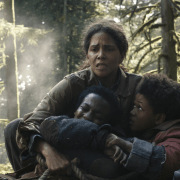
With Blair, I was honestly just grateful he said yes. You always hope to work with people whose work you admire, and then when they show up and elevate you, that’s a gift. I remember the first day we worked together—when the cameras rolled, he looked me straight in the eyes, and I thought, “Oh wow, he’s locked in.” It allowed me to dig deeper into the moment.
As an actor who’s still growing, I was watching him closely, seeing how he navigated those little things. He set a standard, showing me the level of consistency I should be aiming for every time. Since then, I’ve been at both their hips—asking questions about my career, about life. Hubert’s been avoiding me, though—I’ve been trying to take him to dinner for the longest while (laughs).
Joy: The film, alongside the father and son relationship, also deals with toxic culture. So this is to each of you—what kind of advice would you give to anyone who has to deal with toxic culture in any environment?
Ashton James: In a racial aspect, or just in general?
Joy: It could be!
Ashton James: I think for me, I’d say always try to stay true to yourself. Sometimes, when I find myself in spaces that feel toxic, I can either align myself with the space—and in turn, become toxic in some ways—or I can figure out where I meet myself in those spaces, and how I can navigate that while continuing to be the person I want to be, rather than allowing myself to be changed by certain things.
And on a racial level, I think I’m always trying to consistently find my way back to myself—through culture, and through things that keep me grounded in my Blackness and in my identity. So my advice would be: always dig deep to find your way back to yourself.