


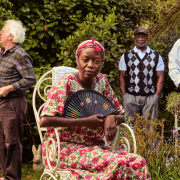
Actor, comedian, writer Andi Osho is makes her Royal Shakespeare Company debut in Fat Ham, James Ijames’ Pulitzer Prize-winning reimagining of Hamlet. Known for her roles in I May Destroy You, Line of Duty and Blue Lights, as well as her work as a stand-up and novelist, Osho speaks with ALT A Review about her journey to Stratford-upon-Avon, the challenges of theatre, and the importance of telling diverse stories on and off stage.
“Every role leaves you a different actor afterwards, you know. Each one changes you.” — Andi Osho
ALT: Firstly, thank you so much for talking to ALT A Review. This is your RSC debut. What drew you to Fat Ham and the role of Tedra?
AO: Tedra, this is my first time working with them, as you say. I wasn’t confident in my ability to perform traditional Shakespeare, but obviously this is something that a lot of actors would aspire to, to be able to work with the RSC.
So when the opportunity came along, and it wasn’t with a traditional text, but it was with one that I felt was really accessible, and yet still had the depth of themes that you find in traditional Shakespeare, had a lot of heart, but it was also funny. It was like it was an easy yes. Well, actually, I made it difficult, but it actually was an easy yes.

ALT: And how would you describe Tedra in three words?
AO: She’s funny, she’s fierce, she’s flawed.
ALT: Fat Ham blends Shakespeare with contemporary themes. What excites you most about that mix?
AO: Well, I think it’s always thrilling to see what artists do with pre-existing work. You know, James has taken the heart and the core of Hamlet, but he’s turned it into something entirely new. So people who are familiar with Hamlet, they’ll recognise aspects of it, but they’ll be, I think, delighted and thrilled and have their beliefs challenged, and new ideas planted by what James has done with this new imagining of it.
And, you know, recontextualising something can sometimes reveal things that you previously didn’t see.
ALT: You’ve worked across stage, screen and page. How does theatre challenge you differently?
AO: Well, I mean, obviously, you can’t just stop and start again. If you go wrong, you have to find a way to navigate through that. And I think as well, not a challenge, a joy actually, of working in theatre is the company energy that sustains you.
So in TV, you could do six episodes of something and never meet some of the other actors that you’re working with. But with theatre, you get to see the same folks every day and build a camaraderie. And, you know, we’ve been very lucky on this production where everyone is brilliant, everyone is a lovely human being. And we’ve been really, you know, the company’s been very supportive of each other.
ALT: Which role would you say has shaped you most as an actor?
AO: It’s difficult because you get a little something from every role you play. Every role leaves you a different actor afterwards, you know. But I think Yellowman, which was the play that I did for the Liverpool Everyman quite early on in my career. It was a theatre piece, a two-hander.


And yeah, we just did a deep dive into so many important themes of just belonging, of colourism, of community, of generational trauma. There was so much in that piece. And because it was a two-hander, it was similar to Fat Ham in the sense it was 90 minutes.
You know, in this instance, both myself and the other actor were on stage the entire time, we never leave the stage. There’s no interval. It was quite an intense experience.
So I probably would say, yeah, that would be the one that has probably helped to set me on a path—whatever path I’m on—that made an impact.

ALT: You’ve appeared in huge TV shows like I May Destroy You and Line of Duty. Which role have you enjoyed most?
AO: Yeah, I mean, every role you play has a little bit of you in it because you’re playing it. And you try, if you want to be truthful with it, you use yourself as the original source material and then grow the character from there.
But I’d probably say Blue Lights at the moment, playing Sandra, because I’ve got to know her over—where are we now—three seasons of this show. So I probably enjoy her the most, especially when she gets to exhibit some of her sense of humour.
Because obviously, no spoilers for people that haven’t seen it, but she goes through quite a lot in the first season. She’s dealing with the aftermath of it in season two. But in season three, the writers started to let her sense of humour come out—a little lightness in her. So that’s been really enjoyable to explore.

ALT: As a filmmaker and novelist, how does storytelling in those formats influence your acting?

AO: I suppose, in a way, having written, it gives me an insight into perhaps what the writer is trying to achieve. When, as an actor, I receive a text, I’m looking at what’s on the page.
A writing coach once said to me that, you know, when a writer is writing something, they’re trying to condense this entire world into one thing, into a script, into a book. And then an actor is looking at that and trying to explode that back out again. So just having that analogy is really helpful—going from my writing into my acting and vice versa.
So I try, when I’m writing for the screen, to make what I’m writing actable and useful to the actor. And when I’m acting, I’m trying to be empathetic to where the writer was at when they wrote. Not paraphrase, not change it for convenience, but really find the meaning they had in mind.
ALT: You also co-produced For Black Boys…. How important is it to you to champion diverse stories in theatre?
AO: Oh, yeah, of course. One hundred percent. It’s so important.
And, you know, I had the opportunity to be part of For Black Boys… on maybe its third or fourth run when it was at the Garrick Theatre. I’d already seen it once before and was really moved by it. So when the opportunity came along, it was sort of a no-brainer.
But yeah, 100 percent, it’s so important to have voices in the arts that represent the entirety of who we are as a nation, as a people. But it’s also really important to champion the idea of diversity behind the stage and behind the camera.
What had happened for a while—and it is changing now—is that white producers would go, “Right, we’ve got to do something about diversity.” So they’d put diverse talent on stage or in front of the camera, but behind the camera the decision-makers were still white.
So you’re still getting microaggressions, sometimes not out of malice, just out of ignorance. My thing is, we need to see diversity behind the camera too. That’s real change.
Even when I did I May Destroy You, I was mic’d up by a Black gentleman. And that’s the first time that had ever happened. It might sound small, but it meant a lot.
ALT: A few quick-fire questions. Where do you call home?
AO: Wherever I feel comfortable. It’s not a place, it’s where your heart is. A cliché, but true.
ALT: Your go-to comfort food?
AO: Cheeseburger. Maybe a bacon double cheeseburger! Or if it’s barbecue, wings—it’s got to be wings.
ALT: And finally, what’s next after Fat Ham?
AO: I’ve just wrapped season three of Blue Lights, so that’ll be out soon. And I’ve written my third book, which will be out in March next year. It’s a comedy crime caper, which is a new direction for me, and I’ve really enjoyed creating it.
ALT: And how are you finding Stratford-upon-Avon?
AO: It’s quite iconic. The last time I was here was years ago, doing a survival job. I had to lead a group of American students around the country and, with no training, ended up marching them in the wrong direction when we arrived in Stratford! So it’s funny to be back under very different circumstances.
This time, it’s been lovely. It feels almost like a village. We’ve been taking riverside walks to clear our minds, because comedy is hard work—precision work, technical, lots of moving parts.
The RSC are really good at looking after their cast, too. If you’ve got a niggle or an injury, they’ll sort it out. They really care for actors, and I hope more commercial companies follow that model. It makes a huge difference.
Yewande “Andi” Osho is a British actress, writer, and blogger who had previously been a stand-up comedian and television presenter,