



“Men are like yam, you cut them how you like.”
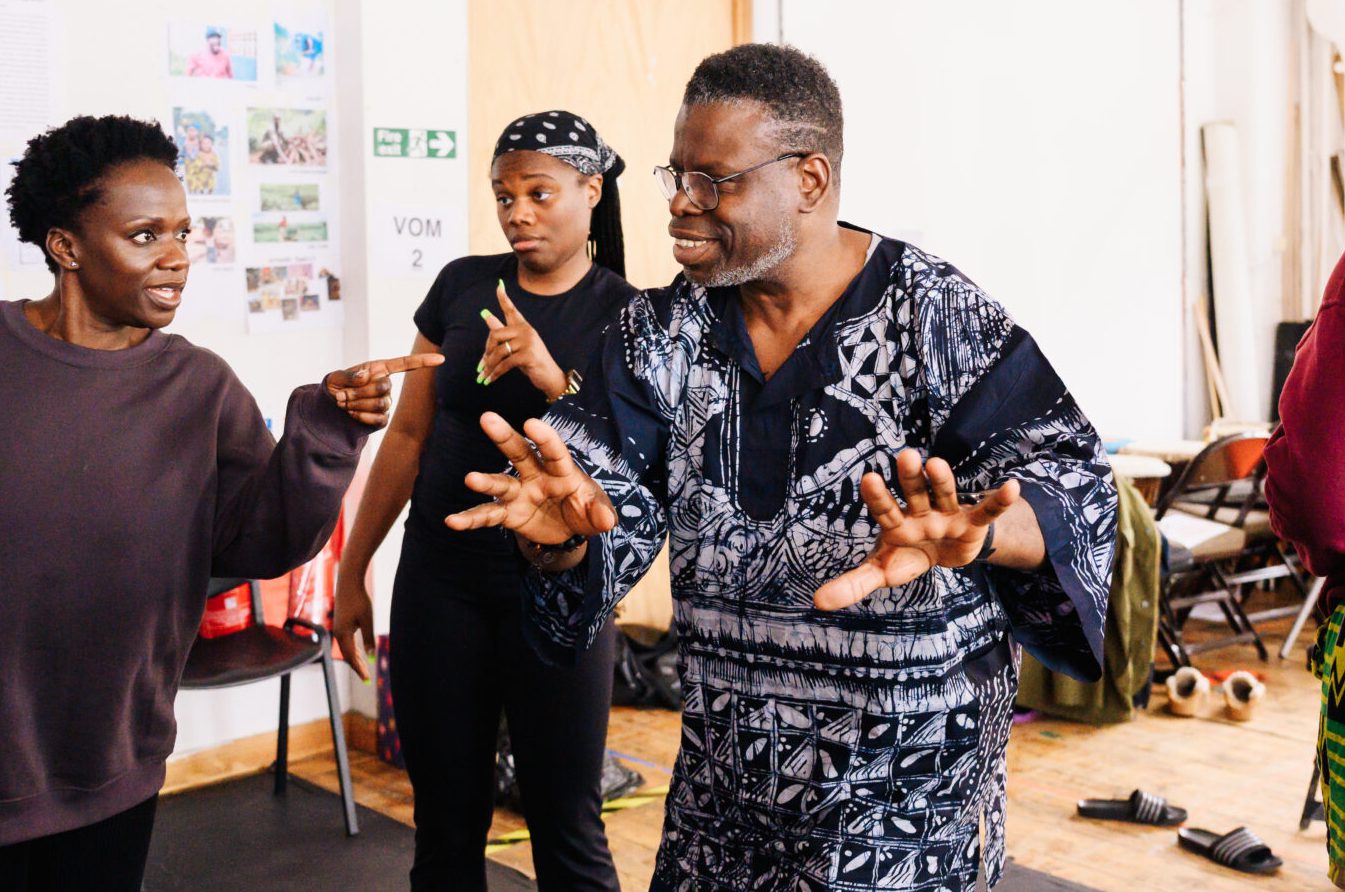
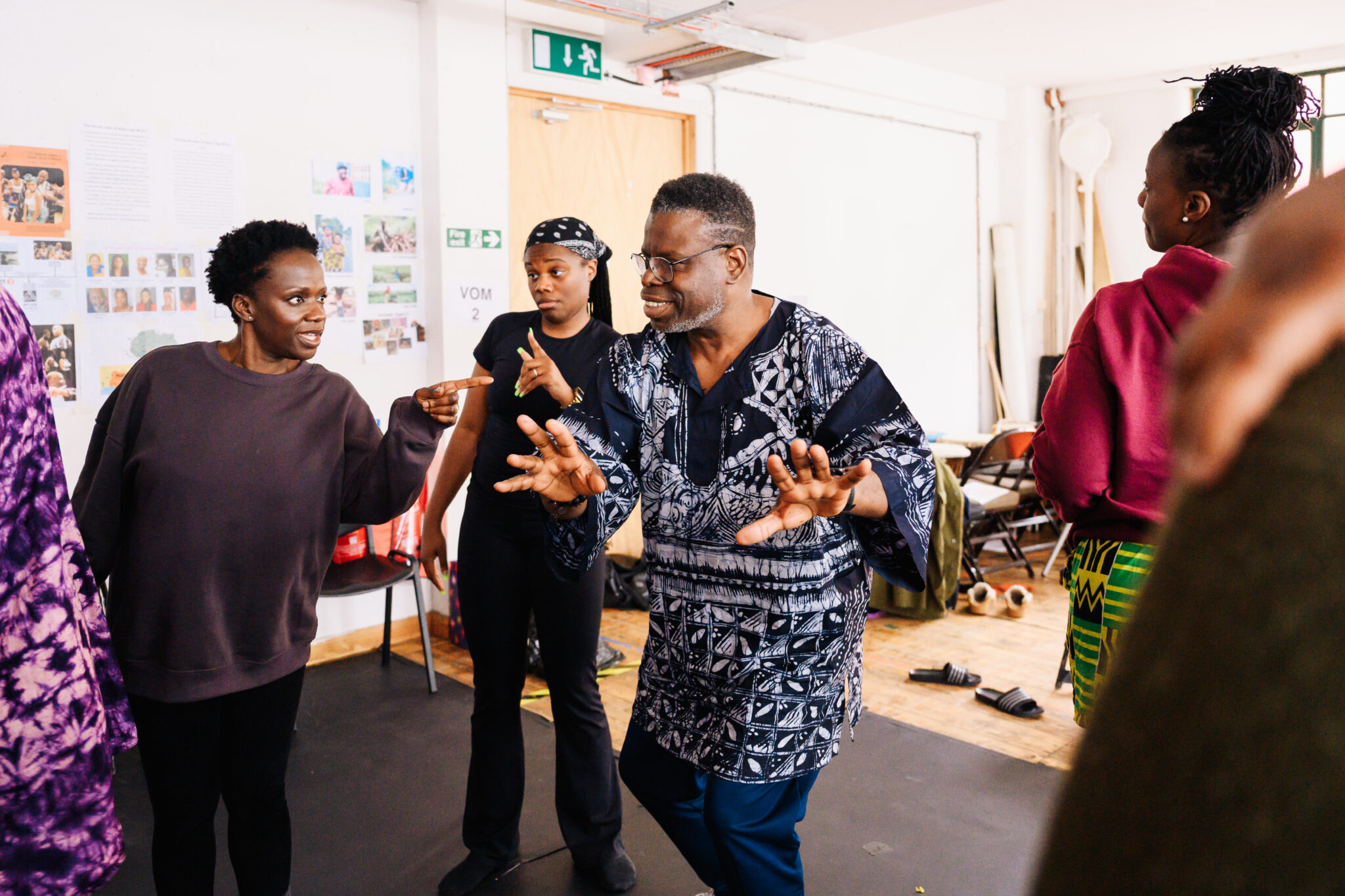
Femi Elufowoju jr once again directs a multi-talented African ensemble in the return of the “spectacular” 2018 smash hit, featuring live Yoruba music, songs and dance. It is produced by Arcola Theatre in collaboration with The Elufowoju jr Ensemble.
In a world where we are being told to shy away from confronting uncomfortable truths, Elufowoju Jr stands at the intersection of culture, resistance, and art. His stage adaptation of The Secret Lives of Baba Segi’s Wives, based on Lola Shoneyin’s acclaimed novel, is not just about performance—it’s a reclaiming of voice and identity. Making a welcome return to the Arcola Theatre in London, through humour, music, movement, and deeply human storytelling, Elufowoju Jr crafts a visceral theatrical experience that races across generations and continents. Femi states, about his theatre making “it has always been to illuminate the human desire for freedom and self-expression”.

Bringing this emotionally rich Nigerian narrative to life has been a deeply personal journey for the director, whose roots in both the UK and Nigeria inform his artistic lens. In this conversation, he shares insights into his creative process, his hopes for the future of African storytelling in British theatre, and the importance of making space for underrepresented voices—not just on stage, but in the very architecture of the industry.
Femi Elufowoju Jr is a British-Nigerian director, actor, and trailblazer in African theatre in the UK. He is the first director of African descent to work on a main stage in a UK repertory theatre, and has helmed productions across the Royal Court, National Theatre, Young Vic, and internationally. Trained in Theatre in Education, his work blends minimalism with powerful narrative tools like improvisation, live music, and ensemble storytelling. With a career devoted to spotlighting African diasporic narratives, Elufowoju Jr is committed to breaking barriers in representation and broadening the horizons of British theatre. Some of his credits include: (Sex Education 2019) (Year of the Rabbit 2019) (Mechanic: Resurrection 2016) (Borgen 2011), directing Verdi’s Rigoletto for Opera North (2021) to name a few. Tickets are on sale now CLICK HERE:
ALT: This play is adapted from Lola Shoneyin’s novel, a bold and emotionally rich piece of Nigerian literature—what was your vision for bringing it to the stage?
FEMI: My journey with the story began in 2012—it was love at first paragraph. From that moment, I envisioned it on the Nigerian stage, where its themes, though common, are often shrouded in silence. Lola was determined to break the taboo, and I felt compelled to join her in shattering that myth. The real breakthrough came when we settled on performance styles: a theatrical adaptation blending narrative, song, music, and dance.

ALT: How did you work with the actors to balance humour, heartbreak, and social commentary in the production?
FEMI: A lot of it involved sharing my own research and encouraging the cast to dive into the original text. I was lucky to work with an ensemble made up largely of first- and second-generation West Africans—individuals with deep ancestral ties to the world of the play. That connection made my job easier.

ALT: The story delves deep into polygamy, patriarchy, and secrets within marriage—how do you hope modern audiences respond to these themes?
FEMI: With fascination and, perhaps, even glee. Older audiences often bring a personal understanding of these traditions, but it’s the younger generation I hope to reach—to enlighten them. The world becomes a better place when ignorance is stashed away like an unused glove.
ALT: What part of the story resonates most with you personally or creatively?
FEMI: Personally, it’s the setting—Ibadan, Nigeria. I lived there in the early seventies. The mention of districts like Mokola, Dugbe, or Challenge always brings a smile to my face. Creatively, it’s a beautiful reminder of home.
ALT: What does your collaboration process with actors and designers typically look like? Do you lean into improvisation or prefer a more scripted journey?
FEMI: My training is in theatre-in-education, so minimalism and repurposing props are core to my practice. Improvisation is key. We often hot-seat characters, work from visuals, and develop organically. This production began with a happy accident—discovering Lola’s novel—followed by workshops that shaped it into what it is today.
ALT: Are there specific visual or sound elements you’re using to tell these stories in a unique way?
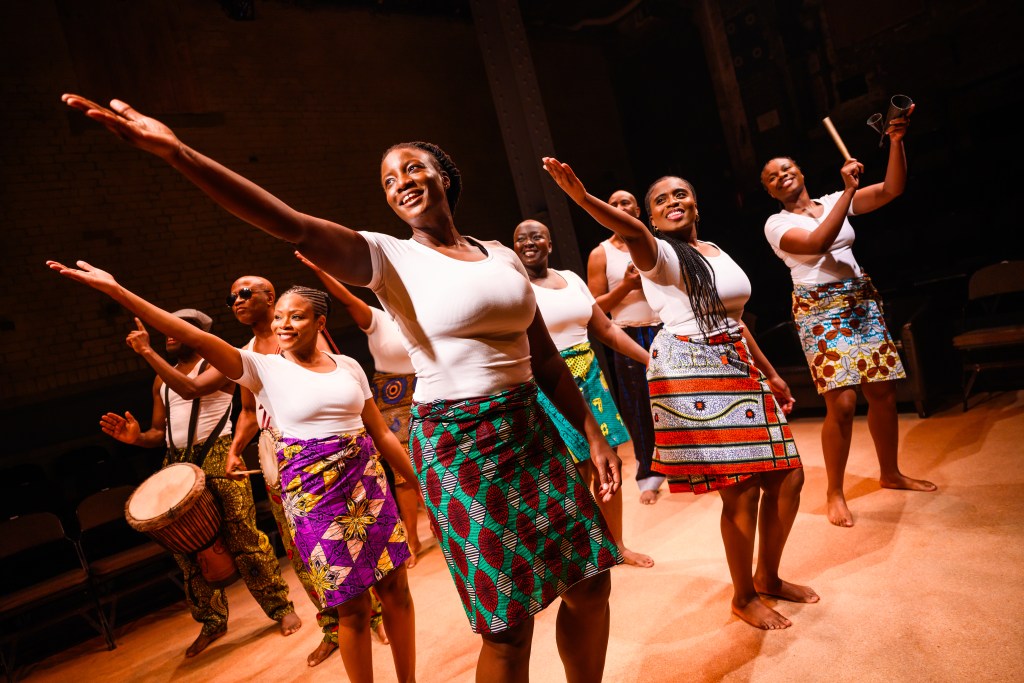
FEMI: This is a rare, stripped-back production—told in the round, akin to the African oral storytelling tradition. There are minimal props, no recorded sound. All music is performed live by a trio of multi-instrumentalists. Songs are sung without amplification, and movement is deeply woven into the narrative.
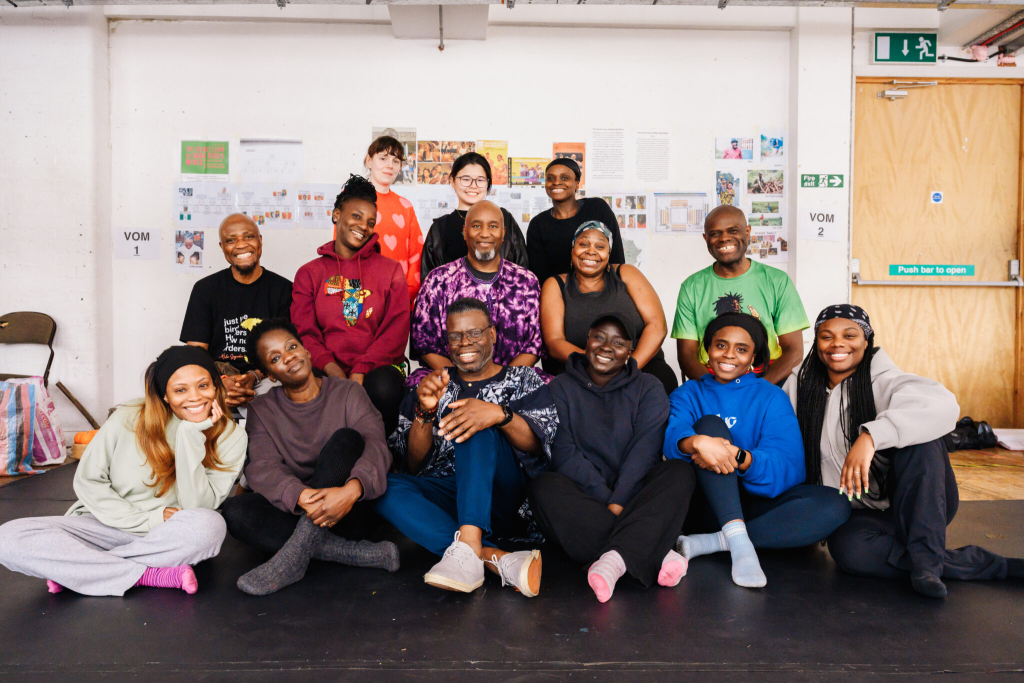
The company: FEMI centre
ALT: What do you want audiences to walk away thinking or feeling after watching the play?
FEMI: Elated. Renewed. Empowered. These stories are universal—crossing boundaries of gender, race, and religion. The core mission—for me, the novelist, and the adaptor—has always been to illuminate the human desire for freedom and self-expression, especially among women whose lives are shaped by geography and tradition.

ALT: You’ve had an incredible career championing African stories on UK stages—do you feel a shift in how British theatre is embracing these narratives?

FEMI: Absolutely—but it’s been a long time coming. My worry is that the consistency we’re finally seeing might not last. When I last raised this concern publicly, the backlash was intense—but I’ll keep speaking out. British theatre is incomplete without our stories—beyond October, beyond tokenism.
ALT: What advice would you give to emerging Black or African directors looking to break into the industry today?
FEMI: Find your unique story—your scoop. Work hard, stay patient. Not everything happens at once. Seek a mentor with honesty and vision. Know your history, chart your path, and don’t wait around. Create your own opportunities.
ALT: Is there a particular dream project, collaboration, or venue you’d love to work with in the future?
FEMI: Yes—the Metropolitan Opera House at Lincoln Center in New York. I’d love to explore Il Trovatore, Verdi’s dramatic tale of love and revenge, for a global audience. He wrote it just after Rigoletto, which happens to be my all-time favourite opera.
ALT: What’s your go-to dish after a long day at work?
FEMI: Casserole beans (ewa riro), fried plantain (dodo), and a salmon steak.
ALT: Where do you call home?
FEMI: Home is where you make it. But if I had to choose, it would be Ile-Ife in West Africa—my ancestral home and the place that shaped much of my early life after I returned from the UK at age eleven. It taught me the beauty of community and shared purpose.
BOOK HERE: https://www.arcolatheatre.com/book/?bookingId=01-2025%3A103&eventId= The show runs until 31st of May 2025