



Celebrating 10 years “Song Queen: A Pidgin Opera,” is a revolutionary opera written and composed by Helen Epega, exploring themes of love, betrayal, and redemption through an Afrofuturistic lens. It’s the world’s first Pidgin English opera, performed in Nigerian Pidgin, a language that connects communities across Africa and the diaspora. The opera follows Kenate, a rising queen, who embarks on a journey to find the “Peace Song” and restore harmony after the Menemeh tribe, who create reality through song, is disrupted by the envious Vrugos. Helen spoke to ALT’s editor/publisher Joy Coker ahead of @ Wilton’s Music Hall Date: 24-26 April 2025 show.
WIN TICKETS: Answer: Who is the writer/composer of Song Queen: A Pidgin Opera? To enter: email the answer to marketing @ alt-africa.com by 5pm on 22nd April. Tickets are for Opening night 24th April Only!!!!

(Support independent publishers follow ALT A REVIEW on Instagram: @alt_africa_)
ALT A: Helen. Thank you so much for talking to ALT A REVIEW in advance, when did you discover music?
Helen: My mum says that I sang before I spoke. So, I don’t remember anything before the age of three, but I remember always listening to like, Sade, Michael Jackson, Kate Bush, and in the background, Fela Kuti.
I grew up in Nigeria, for the first seven years of my life in Benin City, and there was always music around, and it was live music, talking drums and everything like that. So, my earliest memories are surrounded by music, music and family, they kind of go hand in hand.
ALT A: How did it become opera music and knowing you have a voice for opera music, it’s a bit different from, you know, the pop music and the reggae beats and stuff like that?
Helen: I went to stage school for a very short period, when it was clear that that wasn’t going to be the path to medicine. My parents took me out. But my dad’s a doctor, my mum’s a children’s story writer. So, there’s kind of been music and lyrics around.
But I was in a punk band, and I’ve been in lots of different bands, but it wasn’t until I think 2008 when I went to the Royal Opera House in London. And I think that was my first live opera. And I’d just been going, reconnecting with Nigeria, so I was wearing the attire, wearing a big ghillie as well, probably blocking a lot of people’s views. And at the interval, a lot of people said, Oh, how great for you to be here, you look wonderful. And it just made me kind of feel a bit like a novelty.
I was welcome, but it was clear that it was maybe a bit unusual to have someone that looked like me in that space. And because I’ve been revisiting Nigeria a lot, I just imagined having a market scene in the Royal Opera House and watching Wagner. I thought, you know what, I can do that.
Even though it was my first live opera, I just saw it and I just thought, if this could be in Pidgin, this will be just brilliant. Because when you think, for me, I think opera is what you do when the story is so big, so mad, so crazy. It needs a kind of a home or a house to kind of allow it to flourish.

So, I thought, Pidgin Opera. And I just thought that would bring so many people together. And so that was it really. I was like, yes, I’m going to do this. And why not?
ALT A:
Can you elaborate a bit more on the inspiration, and maybe what were some of the challenges and joys, because suddenly you’re saying, I’m doing Song Queen a Pidgin Opera, you know?
Helen: I’m the kind of person where if I have an idea, I try not to put my own limitations on it. So, I just thought of the idea. And I just thought reaching the idea, had I known the journey, but the idea would, you know, it might have been a bit more daunting, but I didn’t know, it wasn’t done before.
So, I didn’t know what wasn’t possible. So that was a positive thing. And really, after I saw that, I just thought it was something that I could do.
It was so big. And I thought it wasn’t just going to be a show that I would do, it would be a life journey. And amazingly, it has been a life journey.
That was in 2008, and the show is now in its 10th year. The inspiration was seeing a story that was so big. And to be honest, quite expensive.
I thought, people look down on Pidgin, but it’s the one language or one dialect that unites Nigeria in a language of 350. Everyone speaks this colloquial language. So, I said, I’m going to bring something of the people to where people don’t expect it.
And that’s why I thought Pidgin and opera, because one is considered high art, one’s considered low art. And I thought, why? Who makes that decision? I’m going to make Pidgin high art, because it’s something that unites people. And it’s accessible.
So that was it really. There wasn’t kind of, it was like a zero to 60. It wasn’t like an in between, because I didn’t know that it hadn’t been done before.
Subscribe to the ALT A REVIEW PRINT NEWSPAPER SUMMER EDITION OUT SOON!!!
ALT A: 10 years, wonderful. And what has been some of the highlights?
Helen: Yeah, the show’s the first debuted in London in 2015. So, since the first show, it’s been 10 years.
To bring the show to Lagos in #Nigeria, the Muson Centre, that was amazing. Performing sold out performances at the Royal Albert Hall Elgar Room.
I think the last show really brought home to me and the team what we’ve done, because people came from Germany, people came from Italy, Isle of Wight, Stoke, Sheffield, as well as London. So, I was like, so although these people might not mention anything on social media, people are kind of following the show. And the person that came from Germany was at the first show in London.
So, it was really amazing to see people grow with the show. And this was a dream 10 years ago. And I don’t want to say I don’t think it could happen, but you don’t always think it can happen.

And it happened. And that’s been those have been the highlights to see just how far the show has gone. The challenges are that a lot of people haven’t seen the show.
And also, it’s not necessarily that the opera establishment is welcoming with open arms. Not many people look like me. Not many people sound like me.
Not many of the composers that people celebrate in opera are even alive. I look very different. I sound very different.
And 10 years ago, there was a challenge. Now it’s still a challenge. But I think I’m more resolute in I deserve to have my voice, to heard when spoken, as human being. I’m sharing something and I want to leave the world in a better place.
I’ve got a duty to keep creating this space and keep making these connections, because I don’t want someone to then have this experience in 10 years’ time and have the same struggles. That would be for me not a failure, but I would have just thought that’s not what I wanted to spend my life doing. I really want people to kind of like you mentioned before, I want people to say 100 years. Helen made a difference. And the challenge is that I do still feel that there are a lot of closed doors in the industry. And I feel that every day.
I can’t even lie and I’m not going to lie about it because sometimes it’s easy to gloss over. When people say, She’s had these sold-out shows, I had to fight for probably every seat, every opportunity and things like that. And, you know, my husband is the executive producer. And when we met, we met at one of my performances and we said, this is what we want to do. We want to celebrate African culture. And we’ve done that together.
He’s made a lot of things happen as well. And just working in a partnership and in a team and sharing your dreams and being open about that.
ALT A: And just really quickly, because you’ve touched on the audience in the 10 years that you’ve had this show. How much has the audience changed or do you think you see more diversity?
Helen: Incredibly so. Amazingly so. The first few shows, I think it was probably more European audiences. And I was really wondering how do I speak to people that look like me? I was assuming that people would see things and people would hear things. But I suppose in terms of the press, maybe there are certain channels and certain communities that the mainstream press doesn’t get.
So, one by one, I’ve been reintroducing the Pigeon Opera to my own community, my own immediate community, and really trying to make sure that people feel welcome and understand that it’s a space where it’s open. It’s from Africa with love. And I want to share in Africa and the Caribbean culture that is so positive and so open that it’s surplus.

It’s not selfish. It’s giving because it is so generous in its blessings, in its creativity, in the arts and the skills. I think that’s really helped to bring more diverse audience or audiences.
And it’s not people from all over the world and the cast is from all over the world. And also, we have #BSL as well. And it shows the wheelchair accessible.
When I say accessibility is key for us, I mean across the board, not just people with a look or sound different. If someone’s in a wheelchair to not be able to attend or if someone can’t hear, they can’t. You can actually still experience our opera, even if you can’t hear.
I think that’s really magical and that’s important to me and the team.
ALT A: Visually, when we come to this show, what can we expect?
Helen: Song Queen a Pidgin Opera is about a family, Menemeh. And it’s a made-up story, but my mom is inspired by a lot of African folk tales and my mom’s stories. The Menemeh tribe, they sing a peaceful reality through the songs that they sing.
The world of the stars called the Vruga become really envious of the prosperity on earth that the Menemeh have created. So, they send temptations. And as the Menemeh succumb to these temptations, they lose their voices and their ability to sing a peaceful reality.
So Kenate, who’s the heroine, which is great, a woman doesn’t die or is murdered or tortured in this opera. In fact, she’s a hero. Kanate journeys to the Venus bushfires to find the peace song, which is the one song that unites all the world’s realms.
I think it’s really poignant in these times as well just to sing about that, because I think whether you imagine destruction or you imagine birth or growth, what you imagine is the reality. So really, it’s important to kind of share that message out. And people can expect pidgin English, Cockney, Patois, Creole, London slang and Ebonics, spoken word, rapping, operatic vocals, of course, call and response.
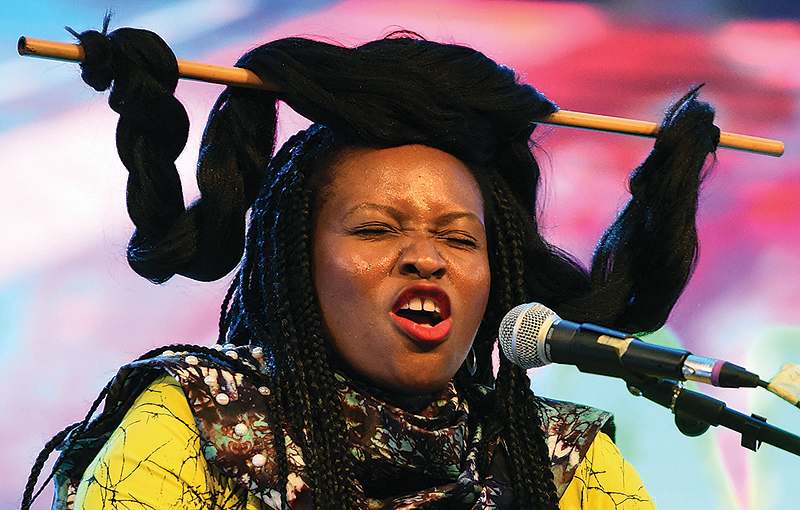
In this opera, the audience actually gets to dance, and you get to talk back and to sing along and then with beautiful, beautiful visual art and contemporary dance. So, it’s a nice melting pot of lots of different delicious kind of things, but it comes together to share that story and hopefully to help everybody feel together, held in that moment and celebrated.
ALT A: Writing and composing it, when you see this production come to the stage, how does it make you feel?
Helen: It makes me feel that anything’s possible. And it reinforces in my mind not to have limitations on myself. There are many limitations, external and sometimes you have internal limitations. But it’s really important for me to, it’s kind of world building, showing ideas that can shape the world.
And I’m hoping this shapes the world in a really positive way. It makes me feel, what’s the word? Unstoppable. When I see something that was in my mind, and it’s now on stage and people are connecting with it, it makes me feel that anything’s possible.
And the closest word I could think of that is just, yeah, unstoppable.
ALT A: You talk about celebrating African stories and how important that is to you and
coming from Benin, because it’s kind of like a well-known country but a little-known country, you know?
Helen: Benin, I grew up there, I thought it was like a such magical, magical place. I remember sort of like singing and dancing in the rain when the rain would come out.
When the rain comes out here, everyone runs away but when the rain comes out in Benin, like all the children would run out. I remember the clay, the red clay sand. I just remember this magical world and it was a mixed world, but my parents exposed me to the more than, you know, the magic, so that’s what I, that’s what I remember.
It’s got a rich history of the Benin bronzes, the Oba, the kingdoms, having some of the earliest city designs and forms of illuminating the land in at night. And it was a very advanced civilisation and really just to continue to celebrate that. And that’s where Benin came from.
I mean, it’s easy to look at something now and think that’s what it is. No, there’s a history that surpasses many of the histories that we celebrate. And it was a millennium, hundreds of years far ahead than of the current superpowers of the day.
So really, when I create and when I present myself, that’s the history that I’m bringing forward. And so that’s the power of knowing one’s history. And to be honest, the Pidgin Opera has grown as I’ve learned that history and I continue to learn. We have a moat. It is, it could do with some renovation. Yes.
But I do believe that Benin will get back, get back to that. And it really continues with having these inward dialogues of celebrating oneself, celebrating one’s culture, decolonializing ideas of superior cultures and things like that. That’s as much external as it is internal.
And that’s why it’s really important for me to celebrate a Pidgin Opera because this is being celebrated on the stage because that’s where it should be. It should be celebrated. It should be illuminated.
And I think that’s really energising to speak about it more, not just kind of be in the studio and working on it. No, now you need to shine a light so that people can see themselves on stage and you can get little ones come and say, yeah, I see me. That’s inspiring.
I wonder what else I haven’t considered. And again, removing those limited thoughts, because I think that’s when we build a better future. And I think as a child, I wanted to be a musician. I want to change the world. Yes, I want to do that.
And it’s still very much alive in me today. So that’s how I feel.
ALT A: For the budding opera stars out there and those who use their voices to perform, is there any two tips you can give to my audiences to use when you’re prepping to go on that stage and use your voice?
HELEN When you’re prepping to go on that stage to use your voice, always, always, no matter what’s happening, even if you’re nervous, and I get super nervous, find some time alone before you go on stage to take a breath and realise that you’re connecting, you’re about to connect with people on a deeper level. Whatever you do is great, because it’s already a spiritual experience. And secondly, you are enough. If you can dream it, it can happen. So dream big. That’s what I’ll say.
ALT A: Where do you call home?
Helen: Ooh, between London and Nigeria. That’s yeah, that’s my home, between London and Nigeria.
ALT A: And if you had a favourite dish?
Helen: Ooh, if they could make a jollof sushi. Jollof if I have to choose, but if jollof sushi, that would be my dish.
ALT A: If we’re talking to the ALT A audience, tell them why they should come and see the show?
Helen: Come and see the show, because it is unlike anything you’ve ever seen before.
It is groundbreaking. It is a riot. And it’s also inspirational.
You’ll hear voices, you’ll hear African drums, you’ll be moved spiritually and bring your dancing shoes.
ALT A: Helen, thank you so much for talking to ALT A REVIEW.
Helen: Such a pleasure. Thank you so much for having me.
@ Wilton’s Music Hall
Date: 24-26 April 2025
Time: 7:30pm Thursday – Saturday & 2:30pm Saturday Matinee
Place: Wilton’s Music Hall, 1 Graces Alley, London, E1 8JB
All performances include BSL and Creative Captioning.
Subscribe to the ALT A REVIEW NEWSPAPER SUMMER EDITION OUT SOON!!!