

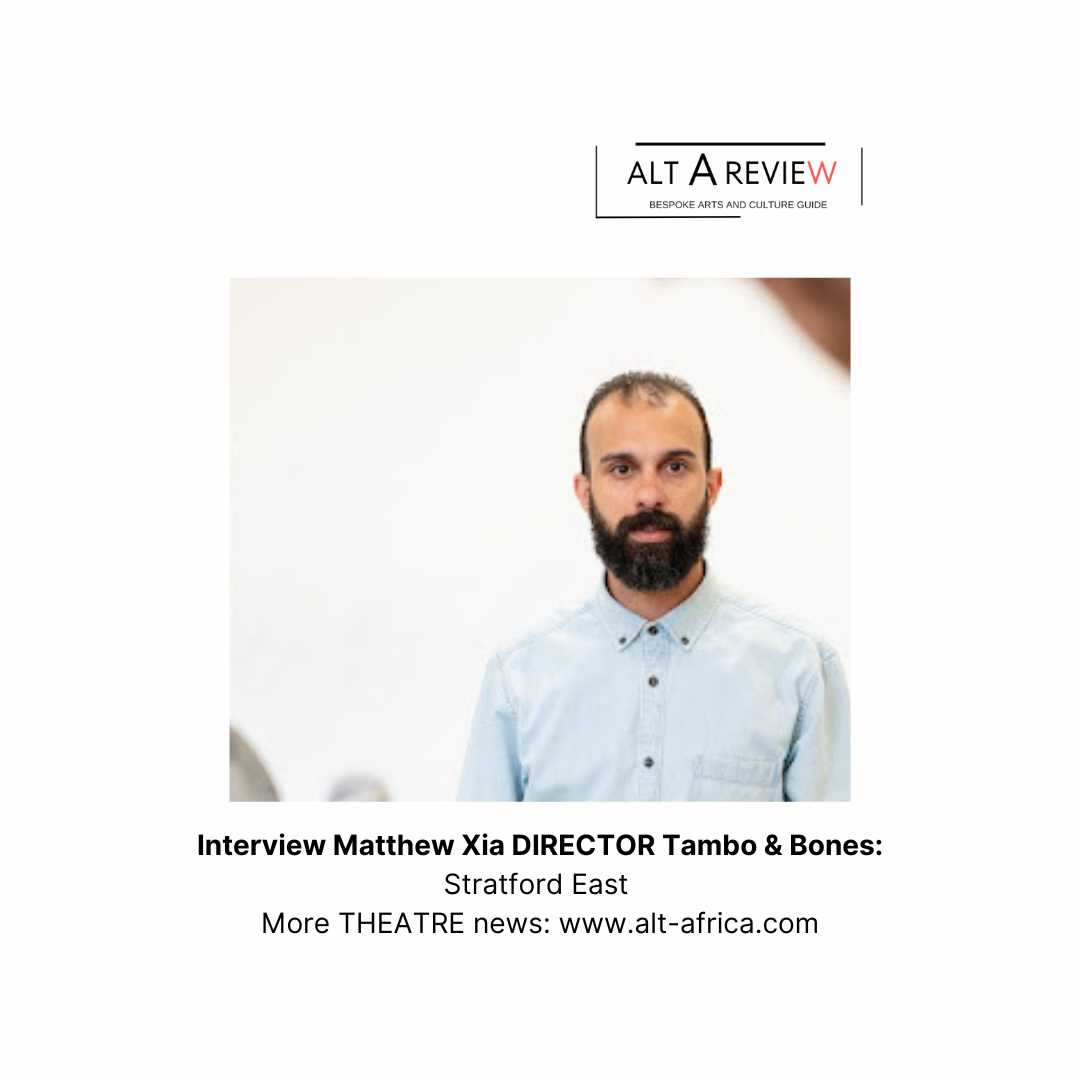
Theatre News: Tambo & Bones Director Interview: Matthew Xia: Shaping a More Equitable Stage

Matthew Xia, Artistic Director and Joint CEO of Actors Touring Company (ATC), has become one of British theatre’s most dynamic and socially engaged figures. Since taking the helm at ATC in 2019, Xia has directed a string of bold, politically resonant productions, beginning with Amsterdam by Maya Arad Yasur, which opened at the Orange Tree Theatre and later transferred to Theatre Royal Plymouth.

TAMBO & BONES Clifford Samuel @cliffordsamuel as Tambo
Daniel Ward @datywar reprising his electrifying role as Bones
✍️ Writer: Dave Harris @staydancingdave
🎬 Director: Matthew Xia @excalibah
His directorial portfolio with ATC includes RICE by Michele Lee and Mojisola Adebayo’s Family Tree—winner of the 2021 Alfred Fagon Award. The latter toured nationally in 2023, underlining Xia’s mission to bring urgent stories to audiences beyond the capital.
Previously Associate Artistic Director at Manchester’s Royal Exchange (2014–2017), Xia directed acclaimed productions including Into the Woods, Frankenstein, and Katherine Soper’s Wish List, a co-production with the Royal Court. He also spearheaded the OPEN EXCHANGE scheme, a trailblazing artist development programme backed by the Esmée Fairbairn Foundation.
Xia’s CV reads as both accomplished and purpose-driven. From directing Sizwe Banzi is Dead at the Young Vic (winner of the Genesis Future Director Award) to his revival of Blue/Orange starring Daniel Kaluuya, his work consistently explores identity, justice, and belonging
He’s a former associate artist at Nottingham Playhouse and has staged notable productions including Blood Knot, One Night in Miami, and Eden. In 2022, he directed Marcelo Dos Santos’ Feeling Afraid As If Something Terrible Is Going To Happen, and co-adapted Hey Duggee: The Live Theatre Show, which won the 2023 Olivier Award for Best Family Show.

Beyond the stage, Xia is a founding member of Act for Change, a trustee for several inclusion-focused organisations, and a respected judge for the Bruntwood Prize and Alfred Fagon Award. In 2019, he received an Honorary Doctorate from the University of the Arts London for championing diversity in theatre.
His creative reach extends beyond directing—under the pseudonym Excalibah, he works as a DJ, composer and sound designer.
Ahead of Tambo and Bones coming to Stratford East Xia talks to ALT’s Editor Joy Coker on his mission to continue to challenge, reimagine and reshape British theatre—amplifying underrepresented voices and making space for the next generation to take centre stage, his love of hip-hop and brown stew chicken!!
Tambo & Bones is at Stratford East Tuesday 29 April – Saturday 10 May 2025 https://www.stratfordeast.com/

.
ALT A: What made you decide to go down the creative path, just to begin with?
MX: Yeah, so I grew up in East London, in Leytonstone, Stratford area, and had, I would say, a tricky childhood that meant that I acted out quite a lot, which I’m now coming to understand, as an adult, was connected to poverty and having a mother who needed to be out working all the time. And I think the thing that I found was that drama and theatre and storytelling gave me an outlet, gave me a place to express some things that maybe I was carrying. I think, like lots of young people, that initial love of art, whether it’s poetry or painting or drawing, is about self-expression. And as we grow, I think we learn that actually there’s a career that can be had within the world of expression and art. And I was really lucky in that my local theatre was Theatre Royal Stratford East. I went down there when I was 11 years old, joined their youth theatre, and haven’t looked back since, really. But it’s been interesting because my love of art has existed in the world of theatre, but it’s also taken me into music production and being a hip-hop DJ and all of these different things.
ALT A: And what would you say was your first professional production that you directed? And from that till now, what would you say has been the massive learning curve, perhaps?
MX: I think my first professional production that I directed was Jean Genet’s The Blacks, which we did at Stratford East. Before I did that, I wrote all the music for a play called Da Boyz, which was an adaptation of The Boys from Syracuse, a Rodgers and Hart musical. But we flipped it on its head and turned it into a hip-hop musical with R&B and bashment and grime and garage and all sorts of contemporary music at the time. But the first solo play, the first play that I ever directed where it was me and my vision, was the Athol Fugard play Sizwe Banzi is Dead, which is set in apartheid era, South Africa, 1974. And what have I learned since then? I mean, that was quite a while ago now, it’s over a decade ago, and those earlier ones are more like 20 years ago. I think I’ve learned that the same process can be used to create the work that I seek to create. And what I mean by that is in 2023, I won an Olivier Award for a production of Hey Duggee, which is a children’s show for zero to six-year-olds, which has absolutely nothing in common with Tambo & Bones and nothing in common with Skeleton Crew, which I did at the Donmar. But I would argue the process by which those plays were created were exactly the same. And for me, that’s about integrity. That’s about treating work for new young audiences with exactly the same respect and rigour that you would create work for adult audiences. And so, yeah, and it’s a team sport, making theatre.
ALT A: And for those out there who look at it and, you know, it’s a glamorous job, but we all know that you might go in the morning at eight o’clock and leave the theatre at 3am and go back again at six o’clock in the morning, kind of thing. So what are some of the strongest qualities you need to be in that space and just being able to do that job well?

MX: Yeah. Like I say, directing, well, the theatre making is a team sport. I think one of the things you’ve got to be is a good coach, a good listener. And actually, being a good coach means being a good listener. I think you’ve got to kind of have the ability to have vision and hold vision and know what it is you’re aiming for, but also the ability to adapt and compromise and shift on that vision when the chips are down, you know, like when things aren’t quite going the way that you want them to. How are we going to adapt our behaviour, our piece of work, our process, the way we’re working with each other to ensure that we can get to that deadline and make the work as strong and powerful as it can be. And I think you’ve got to love people. You’ve really got to love people because people are the resource with which we create this work. Whether it’s the actors, the designers, the front of house team who are looking after the audience, the audience, you’ve got to love the audience. But I think in this game of storytelling, people are the thing that we are most interested in anyway.
ALT A: And talking about storytelling, what are the kinds of stories that you are passionate about telling?
MX: Yeah, they’ve shifted and changed as I’ve got older. I’ve always said that being a hip hop DJ and being a theatre director are the same job. And the reason I say that is because I get a room full of people and I get a room full of people for a limited amount of time and I’m ultimately in charge of the kind of shape of the energy across that period of time. If it’s a nightclub and I’m DJing for two hours, then I’m, it’s more of a kind of a symbiotic response and relationship with the audience. I’m checking what they’re doing and then going, oh, let’s go here, let’s go here, let’s surprise them, let’s take them down, let’s take them up. With theatre, of course, you’ve got a year, six months, a period in which you can work out exactly what you want that energy to be and how you’re going to shape that energy. Yeah, and so the reason that I would say that those two spaces are similar for me is because I grew up in a fairly impoverished background, the music that I was gravitating towards was coming out of housing estates and projects in America and in the UK. So, I’ve always been interested in, I guess, like marginalised voices. And if you look at the theatre that I’m making now, again, the stories I seem to be attracted to are marginalised voices, those who are oppressed and seeking a way through that oppression, beyond that oppression. And sometimes, of course, like looking at housing estates and housing projects, that oppression is often a kind of economic financial oppression that means that people don’t have the opportunities that they want to achieve their dreams. As I’ve grown, of course, I’ve shifted out of that impoverished state that I was in as a child into something that feels more sustainable. And I guess the breadth of the stories that I’ve become interested in has also grown with that. But I would argue that I’m still always wanting to, in a way, put political statements on the stage. So even when we think about something like Hey Duggee, which is a CBBC TV show for toddlers, I think Hey Duggee is quite political in its own quiet way – for children. And the way that it’s political is it’s completely non-judgemental. One of those kids in the show certainly has a degree of neurodivergence. One of the characters is a crocodile and his parents are elephants. And when you ask the makers of the show, why does Happy have elephants for parents? They say, because not all families look the same. For me, that is teaching children to be accepting of difference and empathetic towards others. There’s always a kind of political gesture, I think, at the heart of what I’m doing.
ALT A: And since you have been in this space, how much do you think the industry has progressed in terms of telling these kinds of stories on diversity?
MX: Oh, I think it’s a pendulum, Joy. I think it swings to and fro. Sometimes we’re winning and then we’re not. And then we’re winning again and then we’re not. And I think the biggest problem that we’re facing is that it’s nearly always a tokenistic gesture. As opposed to a lived in principle of putting the world that we live in on stage and off stage, filling the offices and the corridors and front of house team with the people who look like the city we look in. It was really lovely, I think, seeing so much success at the Olivier’s in terms of nominations and our art being celebrated. And there is definitely a shift, you know, it would be, I think, crazy to say that we’re in the same place we were in the mid-90s or in the 70s. So, there is evolution and there is change. But I am quite an impatient person. So, I want more change, and I want it quicker.
ALT A: Let’s talk about Tambo and Bones. What was it about David Harris’s writing that made you want to Direct this production?
MX: It’s audacious. This play is so provocative. I say naughty, but naughty makes it sound childish and it’s not childish. It’s quite complex and quite profound, but really easily accessible. What I love about the play is it is exploring some really, like I say, profound ideas, like the relationship between capitalism and fascism, or it’s examining the transaction between white spectatorship and black performance. And yet it’s silly because it’s a satire. Most of the time we’re laughing at how ridiculous the thing is we’re watching. But that comedy, that release, that relaxation that comes with comedy and the safety of that comedy takes quite a twist and a turn as we move towards the end of the play. And I think it’s shocking and I think it’s brilliant and I think it’s funny. And I think ultimately it equates to a really unique and very special night out in the theatre. And I think that’s what I’m always chasing. I want a trip to the theatre not to be like a trip to the cinema where you can almost forget it on the bus ride home or on the train journey home. I think with theatre I kind of want it to arrest people almost, to hold them, and then to keep them thinking and talking about the thematics of whatever they’ve just seen for years to come. And so, I think what we’re trying to do is create events in the creation of theatre.
There are loads of things we’ve done to the play that ensure that an audience can’t stop thinking about it on the way out. They’ve got to take it home.
ALT A: Can you talk on the two protagonists? Who are they? What are their motivations?
MX: Tambo and Bones are historical characters in the minstrel shows, in the real minstrel shows of the late 1800s, early 1900s. And by that I’m talking traditional black and white minstrel shows, white performers impersonating black people, black lives. And there was very often someone called Mr Interlocutor, and he was often white, and he stood in the centre of the stage. And then there was a semicircle of minstrels around him. And at the end of these semicircles, the two end men, as they were called, were Mr Tambo and Mr Bones. Mr Tambo was called Mr Tambo because he famously played the tambourine, and Mr Bones played the castanets. So, these are famous historical fictional characters. What Dave Harris has done is he’s taken Tambo and Bones, and they find themselves entering the stage with a complete awareness of the audience, but they don’t know they’re minstrels. So, they’re trapped in a minstrel show. And this is a thing they discover early on. They discover that someone with power that they don’t have, authority they don’t have, has written them into a minstrel show. But they’re real black people in a minstrel show. They’re not white people pretending to be black people in a minstrel show. And so, they want to work out who put them there, how do they get out of it, and how do they get even with the society that has put them in this position. It’s very clever, this play. It spans 500 years. So, Tambo and Bones start as minstrels. Once they work out that they can have autonomy over their own lives and their own existence, they work out how to move from getting quarters to getting dollars. And once they get dollars, they think they can change the world. So, I think that’s their objective. And actually, the objectives are interesting and split because Bones is a kind of grade A capitalist. He just wants to make as much money as he can. He’s a hustler and he will do everything he can to get as much money as he can. And that then replicates itself. Once they move past the minstrel show, they become hip-hop superstars, and he is dripping in bling. He’s got the grills, he’s got the rings, he’s got the bracelets, he’s got the chains, he’s got the spinning chain with the dollar sign going around. He’s got the fur coats. That’s the world he wants to live in. Tambo has a different agenda. Tambo wants to end racism. Tambo starts this play being so tired by the world in which he has been thrust into, and he just wants to sleep. But as he says in act two, I did want to sleep, but now I’m woke, and I want to change the world.

ALT A: So, this is a two-hander.
MX: Yes, that’s how we like to talk about it.
ALT A: Yes, yes. Can you just talk on the two actors and why you chose to work with them or what you like about working these two actors? Because I know that it was done before, wasn’t it?
MX: Yeah, so just one of the actors is different this time around. So when we did it in 2023, it was Daniel Ward playing Bones and Rhashan Stone playing Tambo. And in our 2025 production is Daniel Ward, still playing Bones, brilliantly. And Clifford Samuel, fantastic actor who’s come on board to play Tambo. And I think what this play requires is such a breadth of skills. Minstrel shows, so they’re clowns. It doesn’t even say in the stage directions, enter Tambo, a minstrel. It says, enter Tambo, a clown. Enter Bones, a clown. Their clowning abilities are top-notch. They are so funny. They make ridiculous choices. And I think the important thing about clowns is those ridiculous choices make complete logical sense to the clown who made the choice. Like the clown who decides they’re going to try and fill up their car with orange juice as opposed to petrol, for that clown, it’s a logical decision to do that for some reason. And it’s the same in this play. So, there’s a kind of a truth to their silliness. Then these actors have to become hip hop superstars, the breath control, the lyricism, the rap, the dance moves, whilst still holding on to a slight degree of clowning. And then as we move into the third act, which is the act we don’t talk about because it’s spoiler central, they are now no longer clowns. They are quite, I would say, quite dangerous individuals. And so, what it requires is that huge breadth of skills to be able to be silly, playful, funny, but then also to kind of be able to deliver such pathos and pain and depth. And both of these actors can do that. I mean, they’re being celebrated for it in all the reviews. I guess we’re pointing out the surprise in the twists and the turns. And we can only have those surprises twists and turns because we’ve got two very talented actors with their hands on the steering wheel.
ALT A: And can you quickly talk on the musical choices?
MX: I spent the first 15 years of my career as a hip hop DJ. I was the first DJ signed to BBC One Extra in 2001. And I hosted a hip hop show for five years, interviewing lots of my favourite hip hop stars there. So hip hop is in my blood. I grew up on it, love it. I mean, yeah. Yeah, yeah. So, Dave Harris in the play, in the middle act, where they become hip hop superstars, he indicates, I think they perform maybe five songs. The middle act is essentially a concert that they’re performing. And he says, this song should sound like, and then he’ll give you a reference point, call in the gang, but as sampled by Ma$e for Feel So Good. This song should sound like mid-2000s snap era hip hop, like Chingy. This song should sound like Kendrick Lamar. So, it was really great to kind of be told what world we had to create musically and then to go have fun replicating some of those songs. Yeah. And I mean, it spans, it probably spans about 20 years of hip hop music production from the kind of more disco influence stuff like Kurtis Blow and The Breaks to kind of gangster rap with Dr. Dre and Snoop Dogg references to kind of jiggy-era Will Smith style party music. But I mean, I think the thing that makes this play so special is we really embrace the truth of each act. So, when it says minstrel show, we’re going to do a minstrel show. When it says hip hop concert, we’re going to do a hip hop concert. When it says whatever act three is, we’re going to fully embrace it.
ALT A: Where do you call home?
MX: Wherever my family are. And what I mean by that normally is wherever my child is.
ALT A: Wonderful. And if you could have any meal delivered today, like favourite meal.
MX: Right now, the thing that came to mind was brown stew chicken.
ALT A: And finally, if you’re talking to my audience, why should they come and see this show?

MX: So why should the Alt Africa audience come and see this show? Because a number of reasons. The first thing is because it’s a great night out in the theatre. It’s surprising. It’s like a rollercoaster ride. When you think that it’s going to be offensive and problematic, it subverts that. Every audience member that has seen this play has loved it. White audience members, Black audience members, and everybody else. Because they get what it’s doing. And it’s doing something so particular and so unique that if you don’t see this play, you will never have the opportunity to understand what theatre can really truly do to an audience. Because this is a play that is as much about performance as it is about audience. And so that audience has a role to play in each act. And their role changes slightly in each act. It deals with some really, really, really important themes that I think are pertinent to the Black community. And to the diasporic Black community, whether that’s in the Americas, in the Caribbean, or here. If you have roots that go back in any way, shape, or form to Africa, then this is a play that I think you should probably see. Because it looks at so many complex ideas. But it does it in a really fun and accessible way. There are moments of pain. But that’s because I think what we, as Black creatives and Black artists, have often been asked to sell to white audiences is Black pain, is Black trauma. And in a way, this play looks at that. And it unpicks that. But it does it whilst making you laugh all the way through. Yeah. And if you really need a bit of convincing, go on YouTube and type in Tambo & Bone’s audience responses. And that will sell it to you immediately.
TAMBO & BONES are stuck in a minstrel show.
It’s hard to know what’s real when you’re stuck in a minstrel show.
Their escape plan: get out, get rich, get even.
*One of #TimeOut’s top six shows to watch in 2025. Tambo & Bones is an exhilarating, darkly comic and provocative satire on capitalism and Black performance.
Spanning 500 years, Tambo (Clifford Samuel), and Bones (Daniel Ward) journey from comedy double-act to hip-hop superstars to activists in a future America – contending with the alarming repercussions of a nation torn apart by race. Harris’ blistering satire laughs through our past, blows the roof off our present, and imagines an explosive future for our world and for theatre.