

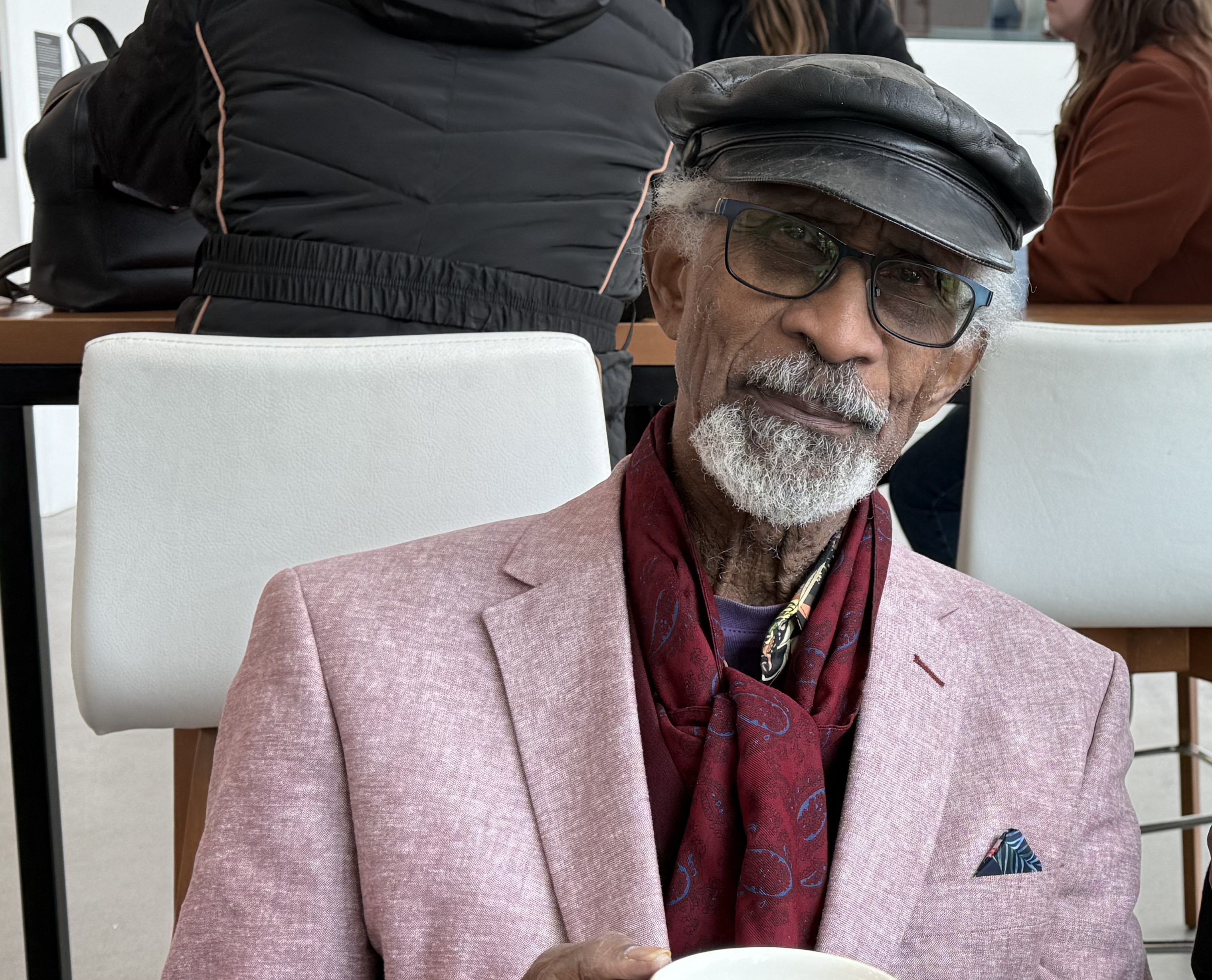
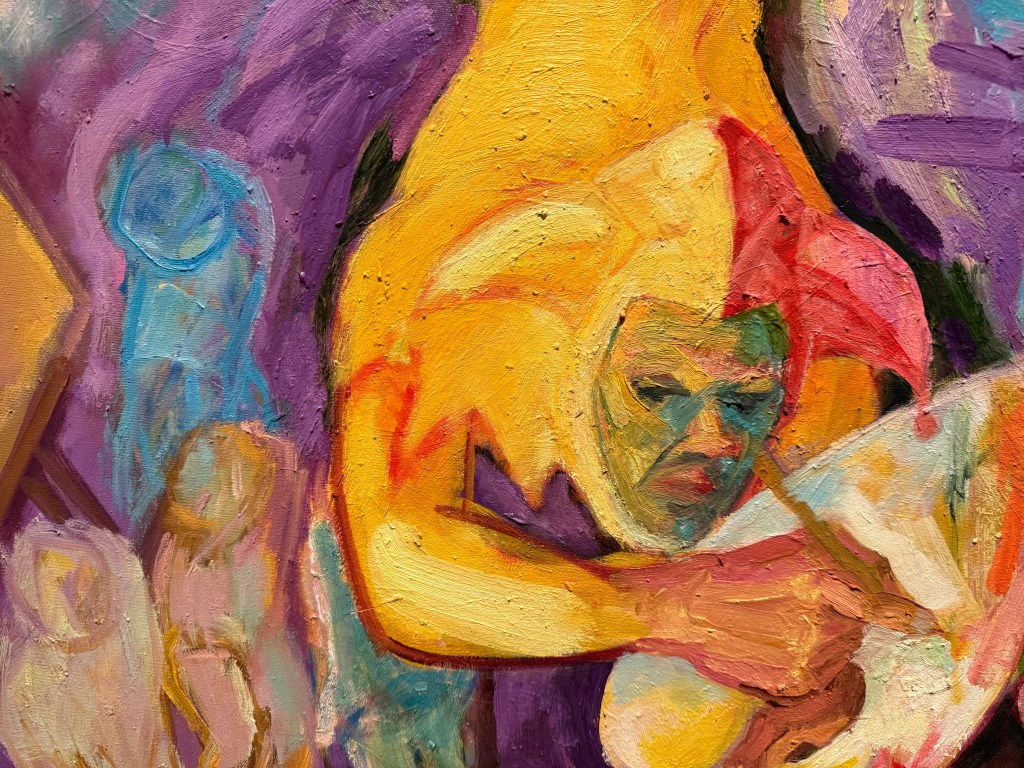
At 91, John Lyons stands tall, in more ways than one, as a pivotal figure in the artistic and literary landscapes of both the Caribbean and the UK. Born in 1933 in Port of Spain, Trinidad and Tobago, Lyons’ work—spanning poetry, visual art, and cultural advocacy—has explored themes of identity, folklore, and post-colonial experience. With a career that spans six decades, Lyons’ journey reflects not only his deep-rooted Caribbean heritage but also his engagement with the cultural dynamics of migration and artistic expression. His latest exhibition, Carnivalesque, is bold, bright, and brilliant—a consistent pattern throughout the exhibition that draws you in to examine every brushstroke, as faces and figures materialise, then dissolve back into the painting, only to reappear in perhaps a different shape. Fuelled by the stories of his childhood and his experiences of carnival, the jumbie-owl, masks, ghost birds and dancing figures take on dynamic forms in his work, creating the “magical” and experiences of the endless street party and mythology.
Describing Carnivalesque, Lyons himself says, “It tells you more about the nature of carnival. It’s broad, it’s about folklore, customs, and how people live—it has a culture in it. That’s why it is called “Carnivalesque.”

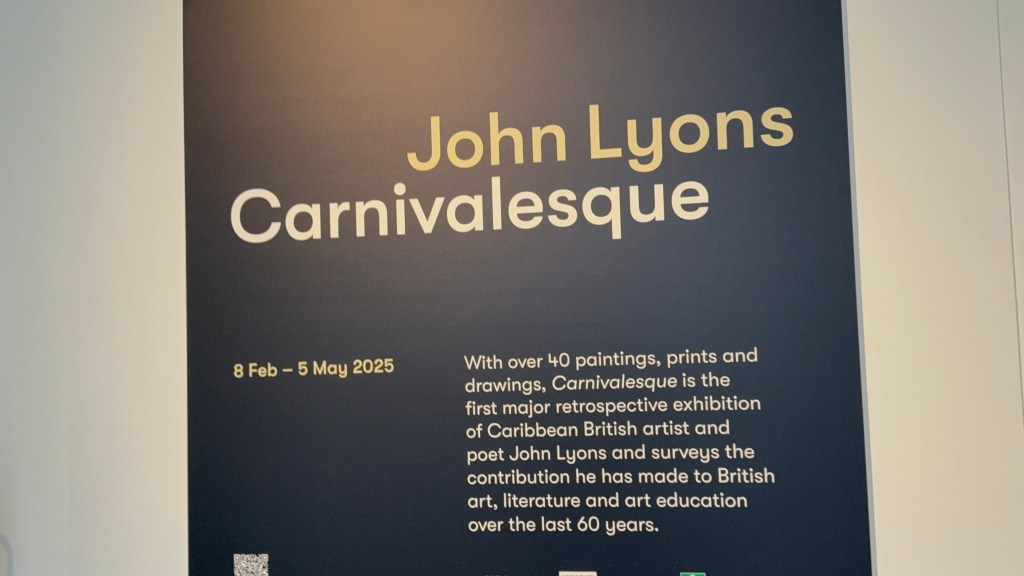
The first major retrospective exhibition of Caribbean British artist and poet John Lyons The Box Plymouth
With over 40 paintings, spanning over six decades, the exhibition is a showcase of Lyons’ profound impact on British art, literature, and art education, with an emphasis on his interpretation of Trinidadian folklore and mythology through both visual art and poetry. It encompasses a variety of mediums, with the walls adorned with his poetry alongside paintings, drawings, woodcuts, and a curated selection of small sculptures and sketchbooks.
At the age of nine, his mother passed away, and he and his three siblings were sent to live with his grandmother in rural Tobago. There, he developed a love for literature, immersing himself in the works of authors such as Walter Scott and Arthur Conan Doyle. In 1948, Lyons returned to Trinidad to live with his father and stepmother. Despite facing financial difficulties, he was determined to continue his studies and passed the Senior Cambridge exam. However, to ease the financial burden on his family, he joined the Civil Service, working for five years, all the while nurturing his passion for writing and painting.

In 1959, Lyons’ dreams of further education took him to London, where he was accepted into Goldsmiths College, graduating in 1964 with a National Diploma of Design. The following year, he earned an Art Teachers’ Diploma from the University of Newcastle-upon-Tyne in 1965. Lyons’ early years in the UK were defined by a deep commitment to his craft. After his studies, he began his teaching career at South Shields Grammar Technical School for Boys. In 1967, he relocated to Manchester, where he worked in secondary schools for nine years before becoming an Art and Design lecturer at South Trafford College, a position he held for 17 years, all while continuing his work as a poet and painter.
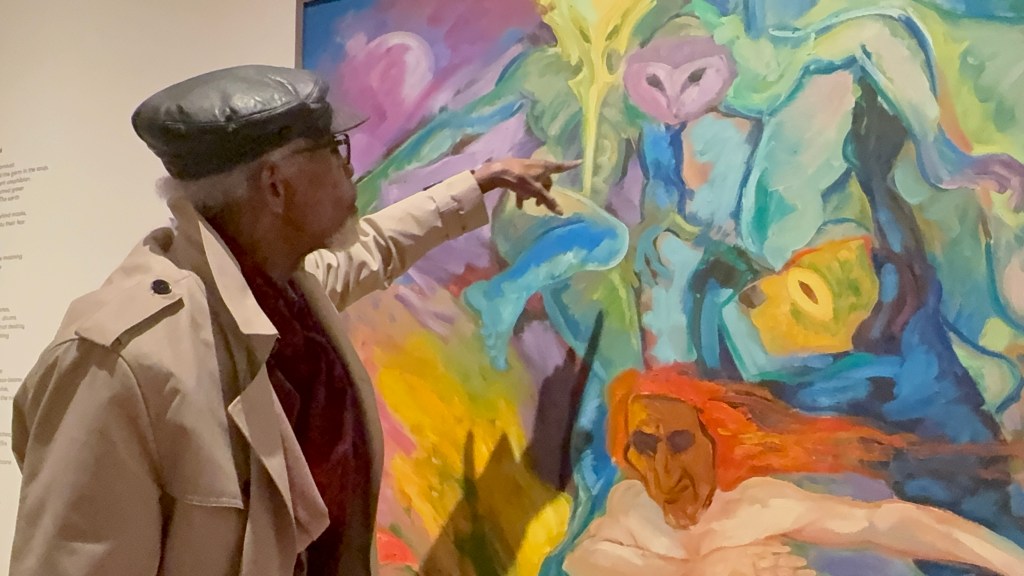
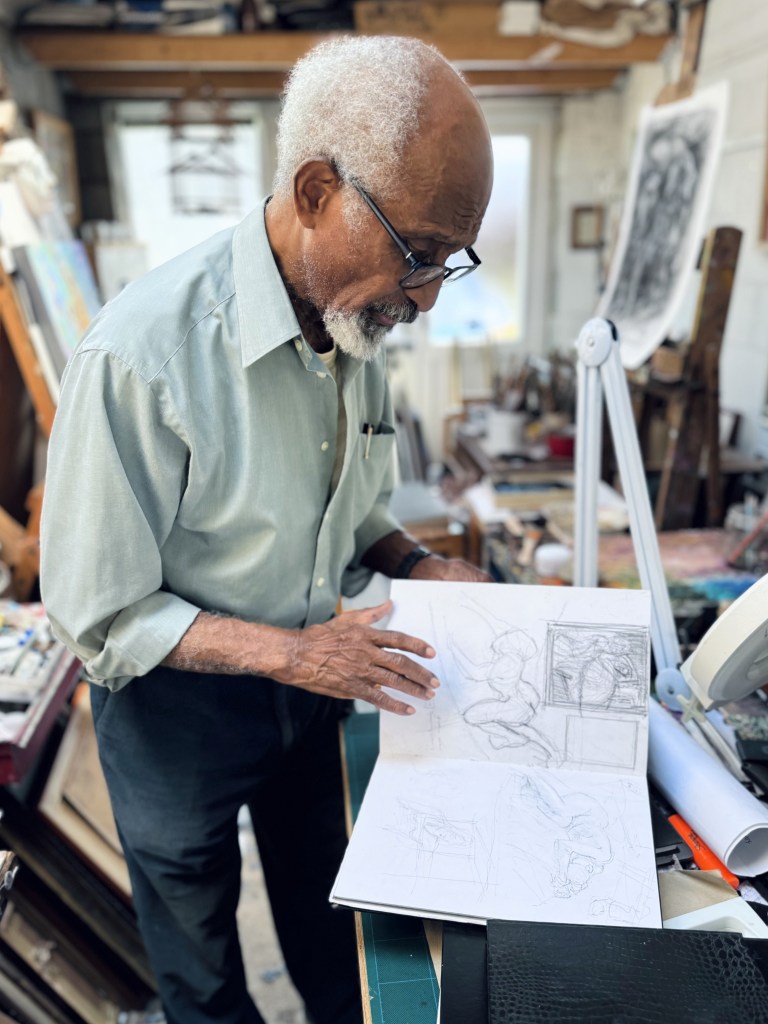
On his artistic approach, Lyons states: “My whole approach has to do with the link between poetry and painting. Hence the use of colour, the use of intuition—that is what I am about. I don’t just look at the surface of things. That’s what I did when I was younger. Yes, I drew very well, but then I learned that art is more than just the surface; you have to go beneath that. That is the essence of my exhibition.”

A much-celebrated poet, Lyons often addresses themes of Caribbean identity, migration, and history. His literary career gained significant momentum in 1987 when he won several prestigious poetry awards, including second prize in the Cultureword Poetry Competition, the Peterloo Poets Afro-Caribbean and Asian Prize, a commendation in the National Poetry Competition, and the Peterloo Poetry Competition. His first full poetry collection, Lure of the Cascadura, was published in 1989 by Bogle L’Ouverture Publications and earned him a major Arts Council award.
Poetry Career and Recognition
When asked how painting and poetry evolved together, Lyons responds, “That is a big question, and it can take a long time to answer, but I don’t see the difference between them—they are both languages. I started reading at a very early age, and I think that reading experience led me to write poetry and short stories, but I also painted. I don’t know exactly when it happened, but it did. Coming to Goldsmiths and seeing modernist artists who helped me—not to imitate them, but to inspire me, like Matisse—was a pivotal moment. I use visual metaphors, just like you find metaphors in writing. I use similes and symbols. So, if you like, the essence of good poetry also becomes the essence in my painting.”
Lyons’ poetry has been included in numerous anthologies, and he has published eight collections of poetry. Notably, his recent works include A Carib Being in Cymru and Dancing in the Rain, both published in 2015. In 2003, he was honoured with the Windrush Arts Achiever Award for his significant impact on the arts in the UK.
Artistic Journey and Exhibition Highlights
Lyons’ art career began in the 1960s, with his paintings exploring themes rooted in Caribbean folklore and mythology. He describes his approach as a “playful dialogue” with the work, using line, shape, texture, and vibrant colour to evoke stories from Caribbean culture. His style is deeply influenced by the folk-art traditions of the Caribbean, with an emphasis on abstract forms and rich symbolism.
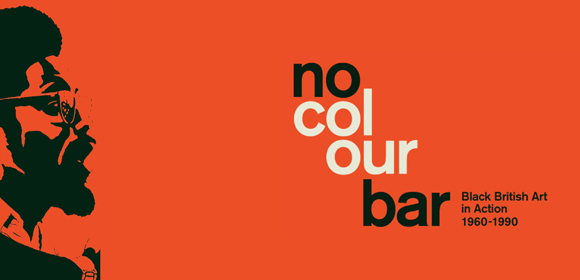
Lyons has participated in major exhibitions, including No Colour Bar: Black British Art in Action 1960–1990 at the Guildhall Art Gallery, which celebrated the legacy of Guyanese activists Eric and Jessica Huntley and their publishing company, Bogle-L’Ouverture. He also featured in the critically acclaimed exhibition Life Between Islands: Caribbean – British Art 1950s–Now at Tate Britain in 2021-22. His works are included in public collections such as the Victoria and Albert Museum, Rochdale Art Gallery, Huddersfield Art Gallery, and the Arts Council National Collection.
Founding and Community Work
Lyons’ commitment to fostering creative spaces is evident in his role as co-founder of the Hourglass Studio Gallery in Hebden Bridge, West Yorkshire. Along with his partner, Jean Rees, Lyons directed art and creative writing workshops at the gallery. The organisation’s educational arm became a charity, and Lyons served as a trustee until 2009, when it lost its Arts Council funding due to public sector cuts.

Carnivalesque: Latest Exhibition
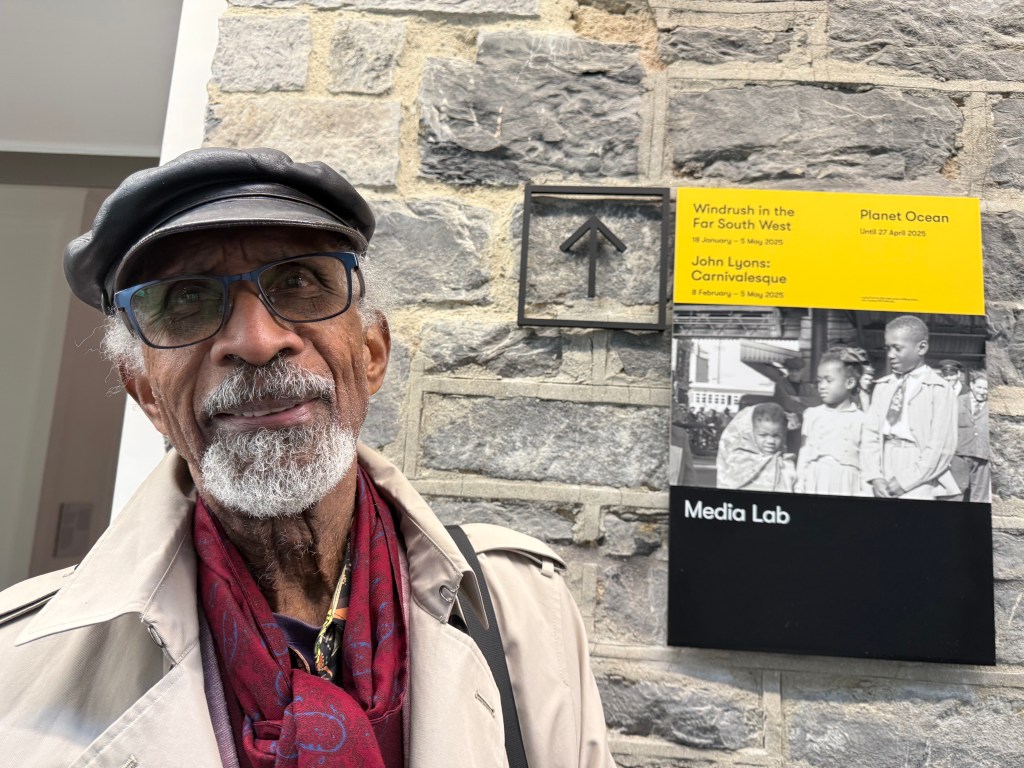
Lyons’ Carnivalesque, is now at The Box Plymouth, showcasing his ongoing exploration of Trinidadian Carnival and the cultural energy it embodies. The exhibition is a dynamic fusion of painting and poetry, with his works displayed alongside poems written on the walls. This immersive experience invites viewers to engage with the spirit of Carnival, highlighting Lyons’ ability to merge visual and literary art to explore Caribbean identity, performance, and celebration.
Legacy and Influence
John Lyons has left an indelible mark on both the literary and art worlds. His poetry and paintings have contributed significantly to the global conversation on Caribbean identity, culture, and the immigrant experience. Over the years, his work has inspired a new generation of artists and writers, cementing his legacy as a leading figure in both Caribbean and UK artistic and cultural movements.
At 91, Lyons’ creativity remains as vibrant as ever. His recent exhibitions and continued literary work attest to the lasting relevance of his voice in contemporary art and poetry. Addressing the elephant in the room, this is his first major exhibition. I asked how the Black Lives Matter movement has contributed to shining a light on Black artists, Lyons responded: “Black lives matter because we come from a culture with rich folklore. We are all part of a tiny cosmic speck we call Earth, and one of the largest continents is Africa—my family came from there. It matters to me, really, because we are all human. If you scratch the skin of a white person and a Black person, what comes out is the colour red. There are many examples that tell us about the unification of the human race. Aside from social aspects, we are all human—and that is what I say.”
Find out more Carnivalesque: John Lyons runs until 5 May 2025 https://www.theboxplymouth.com/events/exhibitions/john-lyons-carnivalesque
John Lyons was interviewed by Joy Coker Publisher Arts & Entertainment Editor of ALT A REVIEW subscribe here