

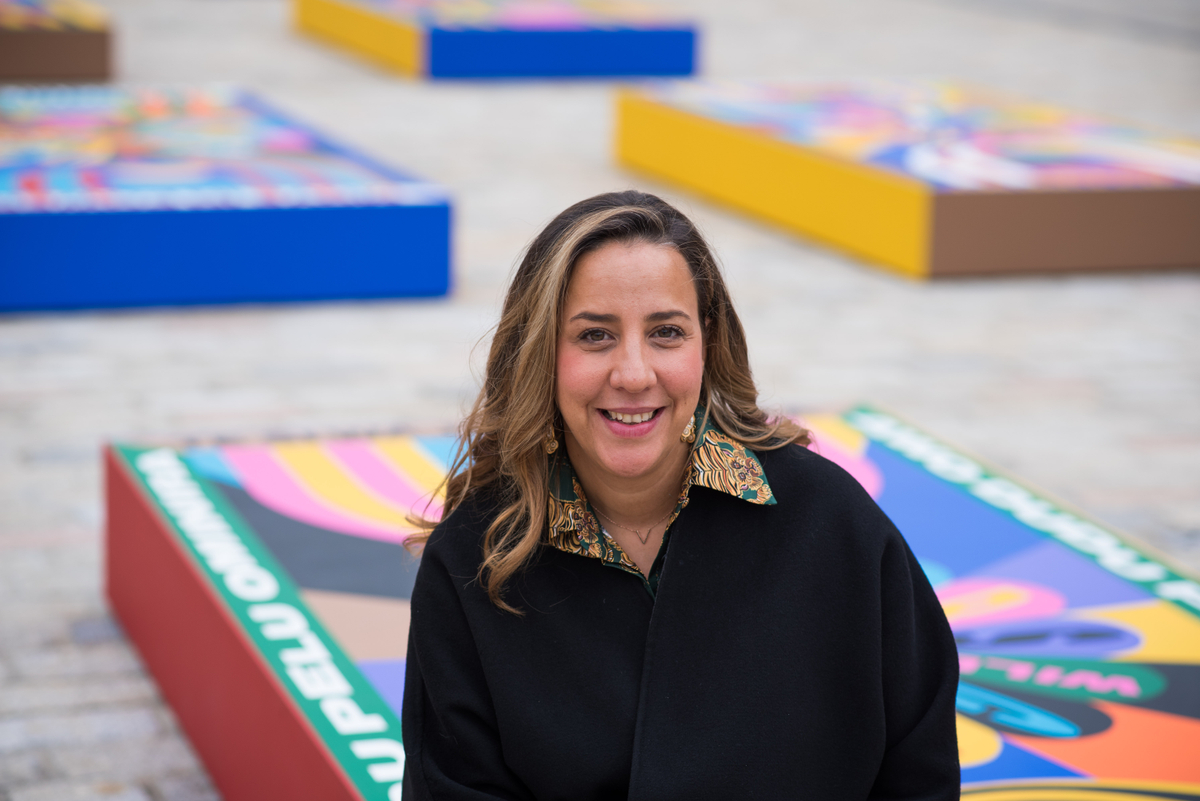
“Each edition we asked ourselves: what is necessary, what can be achieved & how can it be different?” Touria El Glaoui, Founding Director
Founded in 2013 by Touria El Glaoui, 1-54 is the first and only international fair dedicated to contemporary African art. With three editions per year—in London, New York and Marrakech, 1-54 is the leading global art fair committed to providing visibility to contemporary art from Africa and its diaspora. Striving to promote a community of diverse perspectives, including evolving interpretations of the diasporic experience, 1-54 features leading international galleries specialising in contemporary African art alongside artists talks, panel discussions and a Special Projects programme. The fair’s name draws reference to the fifty-four countries that constitute the African continent. The mission was giving visibility to artists from the African continent and the African diaspora on the global stage providing a platform to showcase the work of contemporary African artists and increasing their inclusion in the global art discourse and market.

El Glaoui, discusses the challenges of starting the independent fair with limited seed money, as well as the joys of being able to make quick decisions and stay relevant. Highlighting the importance of developing a strong local collector base on the African continent to support the sustainability of the artists and galleries, rather than relying solely on international collectors.
Addressing the historical undervaluation of African modern and old master artists, and the need to structure the provenance and representation of these artists’ work El Glaoui believes more work needs to be done. El Glaoui, expresses excitement about the fair’s upcoming 12th edition, which will feature special projects, sculptures, and exhibitions highlighting the history and diversity of African art. ALT’s Editor and Founder Joy Coker spoke to El Glaoui who also shared a peak into her own collection of works around the walls of her house.
ALT A: Let’s start at the beginning 1-54 was founded in 2013?
Touria:
Yes, it was launched in 2013. Obviously, I started the company almost three years earlier to launch it, but the actual launch and the first edition of 1 54 was in 2013.
ALT A :

What was the motivation and the mission?
Touria:
The original mission was to give visibility to artists coming from the African continent in the African diaspora. It was kind of making sure that those artists were part of on the global stage, were part of the, I want to say the narrative around contemporary art. I think this is a mission that has stayed at the heart of what we do every day in every edition in New York, in London or in Marrakesh. It’s really about showcasing the best of contemporary African artists and African born artists artist in, I guess those major art hubs like London, New York, and then Marrakesh, which is very important to us as we’re going back to the African continent. I think this has been an interesting journey in terms of when we started, we really took conscious in a way of how much work we needed to do in terms of the non-inclusion of those artists in the discourse, but also the fact that this was a whole part of a continent that was absolutely not included in the history of contemporary art, but also, I want to say the art market in general.
This was something that seemed to have been completely dismissed by, I want to say this art ecosystem. So the reality is like we started in London in 2013. It was, I want to say real success in terms of maybe attention, curiosity, sales, but also it gave us in a way a map of what we needed to do and continue doing in London. But then it was very clear that the importance of the US market and the US visibility was also of extreme importance for this inclusion expansion of visibility for those artists. So, once we had I guess the map of how to do it in London, we replicated the same strategy in New York with two years later in 2015 where we use Frieze, which was always been the date we’ve chosen when we started because it was a very important contemporary art event in London.

So, using the strategy in terms of becoming the satellite event of a bigger event was the idea of getting most of the international collectors interested. So we used the same principle, I want to say for New York where we chose the Frieze New York dates to in a way launch 1-54 New York and where we had been able to operate now almost 10 years counting, I think we celebrated the 10th edition in New York last May. So I think to come back to I guess the core mission, it’s still at our core. I mean the landscape and the market has developed and evolved since 2013. So in a very positive way in many ways when we started, there was absolutely no platforms for artists from the African continent and the African diaspora internationally. And I think if I am trying to remember a bit the landscape when we started, you couldn’t find any of those artists in galleries in Europe or in the US.
There were very few institutional exhibitions happening around contemporary African artists and African diaspora artists around the cities I was visiting, for example. I think this has changed. I want to say we had a lot to do with it. I think we are one of the players that helped to support this development because we are obviously dealing also with the market, which makes, I guess in a way, I want to say the press, but the coverage easier to cover. But the fact that we very early on had two editions in London and New York, which were two, I want to say international capital, art capital of the world happening yearly around contemporary African art. We had a lot of coverage as well and maybe more familiarity over the years by the collectors who were visiting us. Their interests were growing. So I want to believe that we had an impact in developing this market and I want to believe that things have changed. There’s a lot of work to still be done, but I mean I want to say that we were able to be officially part of, I want to say of the art circuit in those seasons, but also making sure that those artists got maximum visibility every time we’re doing a different edition either in London, in New York or Marrakesh.
ALT A:
Art is a luxury industry, but also 1-54 as a contemporary African Art Fair is a business. So, for you, what has been some of the challenges and some of the joys like bringing this to marketing not just even bringing it to market as a business, but also bringing it to the art market and doing what you’re doing. Of course, as you said, there was not much visibility for African artists?
Touria:
So I feel like one of our biggest challenges, obviously the fact that 1-54 is very independent as a structure. We don’t belong to a group of art fairs. It was created with practically no seed money. So, in a way we are starting from scratch every edition it’s like from hero to zero in a way. You are building it up, you’re creating it, and then you have to start all over again for new editions. I think in a way those were the biggest challenges. It was when it’s not something that is already proved as a success. You are in a way facing a lot of challenges, raising sponsorship, making sure also that the galleries are convinced and are willing to take the risk with you when you do an edition. But at the same time, that has been the strength of 1-54 as well. By being small and completely flexible and independent, we’re able to maybe go faster than maybe what the regular large structures.
I think the idea of being a small structure allowed us to make decisions quite fast, stay relevant, understand to where our audiences in all those different cities, but also understand the need of our galleries coming from the continent. Originally, I was several times told, why don’t you do it in Africa? Why does it have to be in London, et cetera. But those are questions in general, I was able to respond really fast because I had the galleries who were in a way, my partners in this adventure where I had their direct feedback on what was going on in the continent and how important for them the international market was as all markets developing. Some of the challenges also are our local collectors on the continent waking up to it and making sure that they are supportive of their local art scenes because that allows the galleries who are participating in our fair to be sustainable and making sure we have a strong local collector base on the continent and we’re not relying only on an international collector base. So this is definitely something that has developed positively, but there’s still a work in progress and we need more of collectors based on the continent to not be completely dependent on an international collector base. But I mean both are very important. It’s definitely in the long term.

Something that needs to be done definitely, I want to say Africa, born and sustainable before, I want to say we create a strong market because, and this was something I wouldn’t have said in 2013, because the need was about visibility, getting those artists to have a voice to be heard, to be seen. But it’s also now the sustainability of those artists in the global art market. They can’t only depend on international collectors. They have also to depend on African collectors based on the continent or part of the African diaspora, but they need to also support and be part of this development of the ecosystem of those African artists. So those are the challenges really for the long term is really to make sure that we have a strong local market on the continent. It’s going to be very important for the long term for making sure that this market stays strong and that we have enough buyers for the supply that we’ll be creating.
But I think the challenges, I think I want to say would be similar to any challenges that a startup would have in terms of creating a good team, creating a market, creating a sustainable business in general. You want to be able to continue in the long term, but I have to say the positive of 1-54, I say it’s boutique human size. It’s also the fact that people are able to have this discovery moment with a lot of, I want to say support from artists, from galleries, people coming in, engaging with the audience, having and taking the time to talk and explain. And I think that is possible in the environment of 1-54, maybe not in a mega art fair. So I think the model worked. It’s not the most, I want to say profitable model in terms of comparing it to my peers or Art Basel or the Armory show where they count 300 galleries.

But for us, I think at this moment what is important is also showing the best quality, the best galleries, the development of each country, sorry, and developing a different pace as well. So it is important to be able to bring a platform that stays relevant until we have a very, very strong market. So I think if we were in the mega structure, which could help in many other ways like leveraging on the marketing cost on the tech, PR costs, all those big costs that we have as a small company, but that could be obviously leverage on a larger cost model made us who we are as well because the needs of what we are supporting change and have changed over the 10 years and it’s becoming more important to stay relevant for the galleries and for the artists today.
And that’s possible when you’re able to have a small organization being able to respond and being very close to your clients. Not be completely distant because you have a large business and not really understanding where it hurts or what is successful that we could continue to do. It’s things that we learn sometimes. I’m thinking we just celebrated 10 years in London, 10 years, in New York and I still feel sometimes that we are at the beginning of the journey and sometimes I feel like we are really strong, and we are powering through the different cycle of the art world.
ALT A:
Talking about an equal playing field in terms of African artists, what does that look like for you perhaps for example, African old masters selling their works for perhaps a fraction of what maybe Picasso sells his works for?
Touria:
So first of all, I think there’s definitely been the definition of modern first of all, which is a bit different than the modern section for I want to say the western world has been overlooked for sure and is in really need of structuration because the problem with the modern is that in a lot of the time those artists were not appreciated during their lifetime. Therefore, there has been very limited amount of referencing, categorizing, having galleries taking care of the estate of those artists. It is very blurred still in terms of the provenance of those works who they belong to. And I mean for us, we took a choice really early on which we are trying to evolve as well. But early on we thought it was too early to present it when we started the fair because we didn’t want to get into with a very small business the realities of provenance, selling a piece of work, then having the family telling us it’s not the right work or it doesn’t belong to the artist.
I think things have also evolved now you have more and more galleries trying to work while the artist is still alive, but at the end of their career where you have now galleries taking care of the estate or agreeing with the family to be the sole representative of those artists so they can continue the work of archiving, doing books, making sure that actually we have something more consistent. I know this year at the fair we are going to have pretty much the most we ever presented of modern artists through galleries. So we don’t have a modern section yet, but we will have highlights of all the modern artists that are part of the show. We already had some over the years because the galleries were of an artist that was based in Europe for example, where the estate was clear where we could represent or do a solo show of a particular artist.
Where I think now, we are more open about it is having the galleries taking responsibility of showing maybe some artists who are not with us anymore, but they are sure of the provenance of the work and are willing to take that responsibility. But I think it is not fair, it’s unfortunate. It’s unfortunate also of our contemporary artists not being valued at the same level as their Western, I want to say counterpart or US counterpart it is a shame. I mean at the same time we are happy to see that for a few, for the happy few, there’s some that are quite appreciated and at the level of some the same generation, but they are unfortunately not as many as we should have. I’m just hoping that this is something that can only change with the strong collector base coming from the continent. We can’t rely on the power of the American market or the power of the Western European market to actually bring them to the level.
It’s also the local demand and we see it for some of our modern artists where you have some Nigerian or South African or even Moroccan fighting at the auction for some of them modern artists, we need to see some of the same, I want to say enthusiasm from auction to the first primary market where you have those collectors also in a way taking pride in seeing the artists being priced at that level and being willing to support where they are today. I mean what I find today, and it’s probably my own experience, but it’s interviewing different collectors, seeing and observing how they act on the continent. They’re always happy to find a deal instead of being like, you know what? This artist is at that price. This is so exciting. Let me join in now while I can and being part of that market now what they will say to me is that, oh, but they can go back home, find it for half price and things like that, which obviously they’re not getting it. The way it should work is that they should get in early enough so it’s affordable and they can make it happen.
But once it’s high, they should be extremely happy that that artist is at that price. Instead of trying to marketing down, they should make sure that they defend in a way the pricing and the value of their artists rather than trying to find a deal so this is where we are, this is what we need to change in terms of mentality and making sure that actually when they see one of their artists being appreciated and valued, they should be joining in and supporting that this is where they are in the market and this is where they want them to stay. If not go higher.
ALT A:
Who are the artists that you just really like the most or bought their works?

Touria:
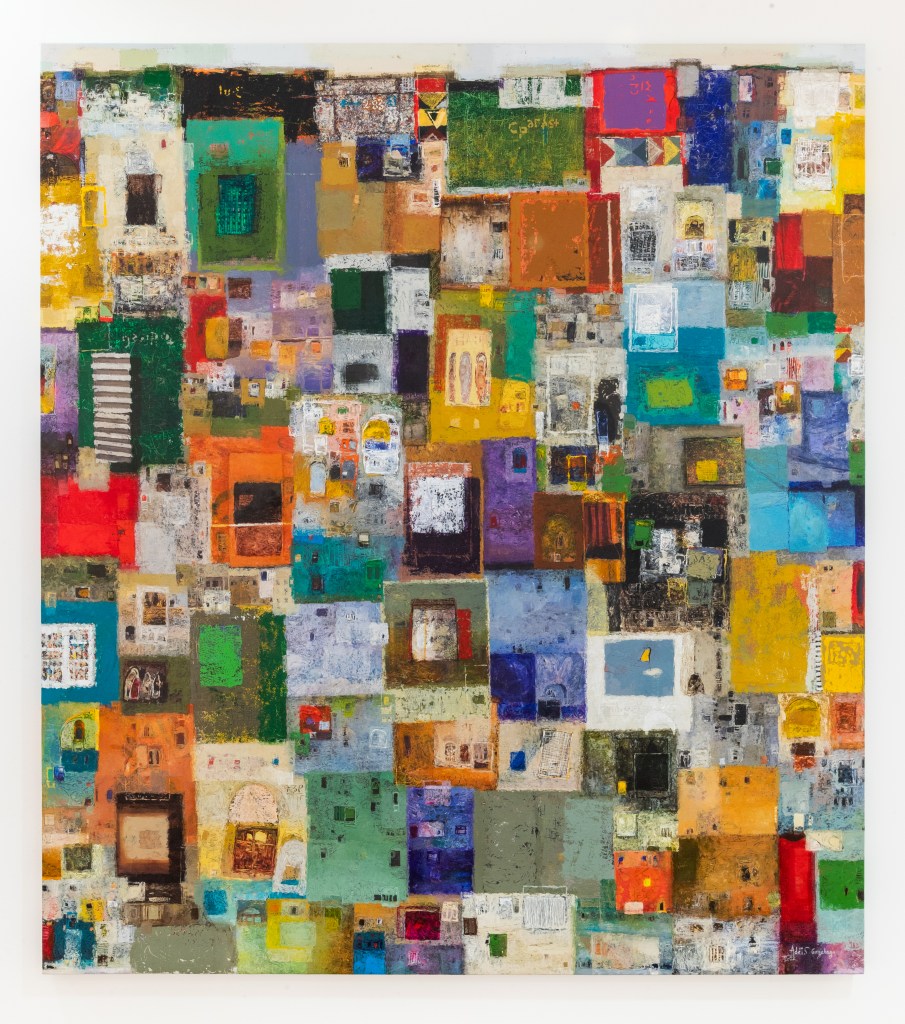
First of all, the list every year is very, very different. The artist that over the years I’ve followed that I’ve acquired, but that I also love their work, and I still can live with it around me, and I still really enjoy it. I have on my right side, I have a beautiful Joy Labinjo, I have a Salah Elmur’s (Khartoum, Sudan, b.1966)
One of my favourites lately has been Francis Mann. I don’t know if you’re familiar with his work, but it’s really abstract.
I really loved Mohamed Melehi ( 1936 – 2020) who passed away. But I mean to be fair, I have also a lot of works in the storage, unfortunately my home is not big enough to have a rotation of those works but that I’m very attached with and if I can, when I buy a new piece at the fair, I put it on that small wall that you see with all the paintings and I take one off so I can live with the new one for a bit, but it’s very difficult to say. But what’s funny is over the years with the fair, I think where I’ll be probably very useful in a couple of years back is like I often have a lot of the first work of a lot of artists.
So the work has changed. Sometimes I’m very excited about the new work but it became too expensive so I can’t acquire it. But it is interesting because I’ve been part of the support system of the early on rather than when they are more established now. But I’m very excited about the work I’ve acquired over the years. But I’m also very excited when I see work that I still want from the new production of the artist and I’m like, oh damn, it’s just too expensive now. I can’t do it. But I’m glad that they pursued the work that they pursued their career, and their career took them where now they’re very pricey as well.
ALT A
1-54 2024, what can we look forward to?
Touria:
Well I think we are really happy with the size of it right now. We are able to welcome every year 61 galleries, which is quite a big thing for us when we started with 17 galleries. I think the Special Project, in addition to the amazing work that the galleries are doing or the excitement for me in terms of the 10th, 11th, or 12th editions is what we can bring to the public where it’s a one-off where you won’t be able to see it anywhere else. And I think part of it is always in London, definitely our sculpture in the middle of the courtyard, which also let the artist work in a very large ambitious size, which is not often something or a challenge that an artist can do a lot of the time. So for us we’re very proud of that project which allows the artists to really think in larger scale and give them a platform to do it. This year we have a very, very different artists that I think will surprise but in a very good way.
It’s going to be quite impressive. I need to leave you a bit of suspense here. We have some cool projects in the lounge. We have this Moroccan French designer who’s like bringing in a huge chess game in the middle of the lounge and it’s going to create quite an engaging area for people not only to meet but to engage with the art around them. I want to say discussion, but also discovery when I first started 1-54 in London is the Nigeria Art Society.
That has been one of the first collective of Nigerian artists in the UK and they are using 1-54 to present a curated show of all the Nigerian artists that are part of that collective, but also some unfortunately who have passed away that are quite important in terms of the history of it all in the UK, but also the possibility of giving them visibility. So this has been a long process of discussion with them being ready. I remember when we were ready but then COVID happened and then it postponed the whole thing again. So they will present an exhibition called Waves of Change: From Aureol to Modern Britain.. It is going to be quite an interesting project and I hope we will be able to give them a unique platform to showcase their work.. There is so much.
ALT A: Thank you.
The event runs 10 to 13 October and will coincide with Frieze London 2024.
Public and VIP Opening
Friday 11 October
11:00 – 19:00
Saturday 12 October
11:00 – 19:00
Sunday 13 October
11:00 – 18:00
Location
Somerset House
Strand, London
WC2R 1LA
United Kingdom