

Norwegian Jamaican dancer and choreographer Harald Beharie is based in Oslo, Norway. and is performing a solo work called “Batty Bwoy” at the Fierce Festival in Birmingham, UK. The piece explores themes of queerness, stereotypes, and reclaiming slurs through the medium of dance. Beharie aims to inject joy and humor into the work while also confronting societal attitudes. As a UK premiere Beharie is excited to share it with a new audience, particularly those from the Jamaican diaspora in the UK and plans to continue touring this work as well as another outdoor performance piece in Norway that also engages with themes of identity and community. Batty Bwoy is a solo which doesn’t start with a question, or a critique, but from a place of play and desire, entangled in violence and charming cruelty. Through a reappropriation of the Jamaican term “Batty Bwoy” (literally, butt boy), slang for a queer person, the work twists and turns the myths of the black queer body, unfolding vulnerable possibilities in an interplay of consciousness and naivety.

Scrutinizing the absurdity of a queer monstrosity, Batty Bwoy articulates through the porosity of bodies and languages, their mouths swallowing and regurgitating the corporal fictions projected onto their skins.
ALT caught up with Harald Beharie to talk about the production.
.
ALT A:
Firstly, can I get you to say a bit about yourself and the title of the event that we’re going to talk about?
Harald Beharie:
I’m a dancer and choreographer based in Oslo in Norway, and I create work on my own and together with different artists. And I’m Norwegian Jamaican, and I’m going to Fierce Festival in Birmingham to share a work called Batty Bwoy.
ALT A:
Let’s first talk about you and how did you discover this medium? Because I think dance is such a beautiful and personal thing, and then suddenly, you know, are a good dancer perhaps. So how did that happen?
Harald Beharie:
I don’t really have an answer for that, but I feel like I started to dance when I was a child, and I always had an urge to make things and that I was using different mediums to do that from when I was a child. And then just going there was something with dance or that it had this potentiality to have these strange moments where you don’t really know what is happening. And these ambiguous moments, which I felt were more concrete in theatre where it’s more concrete narrative or even in music that I feel like maybe it was this ambiguity that made me interested in working with the body and then I was just drawn into it and then I went to, dance school. And then I really didn’t think about, do I want to work as a dancer? What does that mean? Or what does that involve? So maybe it’s in the aftermath of it, of like, okay, I don’t think I imagined writing all of these applications and hustling, but yeah.
ALT A:
So now that you found that you were a dancer, so how would you describe your form of dance?
The 9pm performance of Batty Bwoy on Thursday 17 October is included in our Bear (AKA Full Week) Pass. Click here for more information about our passes.
Harald Beharie:
I took a degree in contemporary dance, so I’m coming from that. But now I feel like it’s more maybe in the experimental side of dance, I would say, or it depends where you’re from, but I feel like maybe I had, after taking my degree, I had a saying that I was really not busy with dance and that I more wanted to, or then a lot of my work was more going into galleries and more happening based. But then actually it was when I made the solo Batty Boy that I got more into because it became a lot more physical than I expected it to be. And then now I stopped to say that I’m not busy with dance because I feel like it’s, my work is really physical, but it comes from more, I don’t work with a contemporary technique it’s more eclectic in how it works with the body. I’m more action based in some sense.
ALT A:
Talking about Fierce, what does it feel like to be part of this festival?
Harald Beharie:
It’s really great. I’ve never been before, but I just heard so many great things about it or that the program seems really great and also that it’s like a queer festival and it seems like that it’s connected to the queer scene in Birmingham. I’m really looking forward to it because we’ve been touring this piece a bit and then it’s a bit different from the venues you go to. Some venues have a really straight and white audience, which is okay, I’m used to it, but it’s a bit daunting, a bit of a boring context. And my feeling is that this is different at this festival so just really excited and it’s also going to be the UK premiere of our work.
ALT A:
Congrats. And tell us a bit about Batty Bwoy the title is quite controversial because there’s been a lot of uproar about people using that term. So why have you chosen it?
Harald Beharie:
I mean it comes from quite a specific place in some sense or because I was listening to a lot of the dance hall music from eighties and nineties, and then as people know there are a lot of questionable lyrics in that music. I found it really interesting when they were using this different kind of slur that it felt that it was almost like a character, it was almost that it was a clear idea of what that body or who that was and that I also found recognizable in slurs in all countries that they have these different names for the Queer body and how that it was like, oh, but what is this body and what is this?
How can I reclaim this body? Or what is it? Then I found it how there’s this almost bodily narratives in this language and this fear of the queer body as something dangerous or something that brings disease or something promiscuous or something unnatural and that there’s something super violent about it, but it’s also something absurd and that I also found this specific, or Batty man or Batty Bwoy or whatever. I also found it a bit not funny, but there is some humor in it also because it’s so banal or so concrete. So then I was like, okay, let’s make a dance piece about this. How can we kind of reclaiming it, but also going into those narratives and what are they, and not just in the aesthetics of what it can be, but also really physical way. What is that body and what is, yeah. And that is used in a lot of different ways. It’s also used to build up this almost, not character, but almost energy that I call battery energy, which can invoke a lot of different things.
ALT A:
That might be a complicated question to ask, but how is that interpreted into dance?
Harald Beharie:
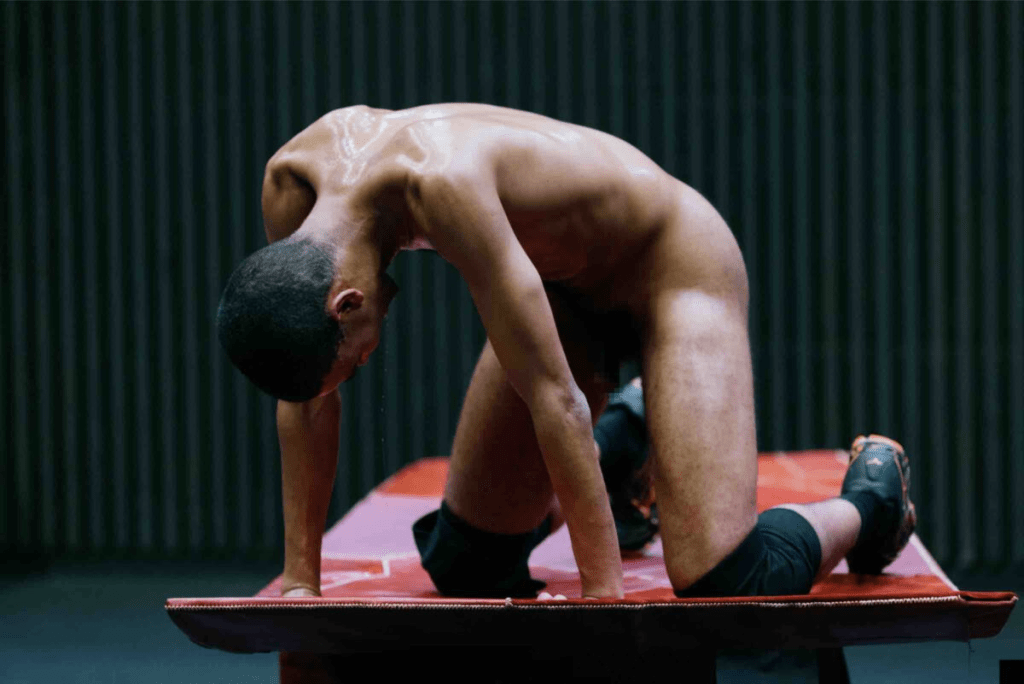
Yes, it’s a solo work, so it’s only, and I’m performing, so it’s only me on stage and it’s together. And the set is super simple actually. So it’s just these platforms that the audience are sitting on and the lights are completely on, so it’s not staged in any way in that kind of way. And then there’s one big red sculpture in steel that is wrapped in red leather. And then,
Harald Beharie:
Right. And then the piece is kind of built up as different actions and that are kind of really stretched out. And one example is, in one part of the piece there is this crawling, which is going for a long time. And here I try to use this crawling material, is that, how can it transform or how can the image of the crawling transform without that, the material has to change in some sense. So the crawling can be about just getting from A to B, it can be something erotic, it can be something frantic, it can be something almost animalistic or it can be pathetic to watch or to do, or all of these different associations can be present in how you view the material.
So it’s kind of like, and that’s just an example of one of the materials, but it follows this logic, but also that it’s really in some sense about really the gaze because it’s, it’s not an interactive performance, but the audience is in the space and you can see everyone in the audience. So it’s also like how do you look, invest into the work? And if you choose to not, you’re also being watched by other people. And so there is a lot of, I feel like it’s really a social space in some sense, which makes it really different from group to group. It can be very tense some places, or it can be really this roller coaster of different things and also be fun.
I feel like the color of it is also, I mean, it’s an intense experience, but I feel like still have really different colors from group to group and who is in the space and what they allow themselves to, which makes it really interesting to perform in different countries because it’s so, yeah, the feeling is so different. And also that for me, it’s really, I try to work with porosity that the audience can change my feeling of doing things even though it doesn’t maybe change the material that much, but that if somebody in the audience makes me feel sad, that’s okay, or empowered or angry, or that I try to let these emotions that I’m of course projecting because I cannot know. But still that, how can they allow that there’s not only one intention or one thing that is right and how the material or the situation should be.
ALT A:
What are the challenges to performing a solo piece as a dancer and what are the joys of doing the solo piece?
Harald Beharie:
I feel like for this specific piece, I think the challenge is that it’s really, I have the power in the space, usually there is a fragility there that everyone kind of has to agree that they’re giving their focus because there’s no lights. If somebody leaves, everyone sees it, that there is to just hold the space in some way. I feel like this may be the most challenging or to navigate in, navigate in the space and with the different energies, which is maybe also this, it’s both the biggest challenge and also the biggest joy because when you feel like you manage, it’s such an amazing, amazing feeling. And then it’s also like you have this, and there’s also another freedom in it also compared to if it’s in a group piece where you can allow yourself things, but you cannot make completely different choices because there are other people that are relying on your choices in some sense. So I feel like maybe that’s the freedom, I guess that’s just a general thing when you’re making a solo, but there is a lot of freedom in it also.
ALT A:
why is this important for you to be able to go up and perform this piece of work? And what is the message you would like to send out to the people out there who are just not, it’s just not in that space. Do you know what I mean? Who feel like they have the conceptions or misconceptions? And so what is your message to them really?
Harald Beharie:

Yeah, I think maybe it wasn’t really important to reclaim that a specific slur. I just used that because I thought that was the most used but there’s still a lot of humor in it in some sense because it’s also going into those stereotypes like, okay, you think you know what that is? I will show you what that is, and then you’ll have to deal with it. And that’s also not going into a victim thing that’s also doing, I find it also that there is a lot of joy in it also. So, for me it’s this dual thing of it being like there is this story, it is also very violent, but there is also a lot of joy in it. And also taking this and playing with it.

ALT A:
You said this is your first time in terms of this is a queer space because sometimes people think this space is just for queer people. It’s a no go area for anybody else. So what would you like to take away from this experience?
Harald Beharie:
I mean, for us, it’s just super intriguing to share our work in a British context. And maybe also because it’s like, well, I don’t know their exact audience, but there’s very few Jamaican people in Norway, and I feel like in the UK there’s a bigger community. So, it be great people from the diaspora coming to see the show.
ALT A:
Where can we expect to see you next?
Harald Beharie:
We’re touring this piece a bit this fall. And then I also had another work that premiered earlier this year that’s an outdoor performance in the forest actually, but with people from the diaspora that have been living in Norway. So we’re touring that piece a bit. Yeah, so now it’s mostly touring.
ALT A:
What is the creative industry like there. Do you have black history month in Norway?
Harald Beharie:
No, not really. I feel like it’s starting to change now that there’s coming more, more and more people and then more different collectives that are organizing things. So, I feel like we, compared to the UK feel like it’s really baby steps, but I feel like things are changing, or at least where the contemporary dancing scene is very, very white or it’s been really divided, from the more street scene. But things are changing now. There’s a ballroom scene growing, things are merging a bit more. And there’s also more interesting conversations about blackness in the arts and black artists organizing different communities and collectives. So I feel like things are happening, but it’s really not the same state as in the UK or my impression of it. But at least I feel like the conversation is in a different place.
ALT A:
Thank you so much for talking ALT. I hope the show goes well.
Harald Beharie:
Thank you.
Harald Beharie (Oslo)
Batty Bwoy
Wednesday 16 October 2024 – Thursday 17 October 2024
Birmingham Hippodrome, Patrick Studio
Presented with FABRIC and performance, possession + automation
75 minutes | £15/13 | 18+
@harald.beharie