

……“all I can do is continue to do the work that I do, and all I can do is continue to shine light, shine the light on stories that I feel are important to tell and represent all of the intersections that I exist in. And hopefully it resonates with other people.” JUSSIE SMOLLETT
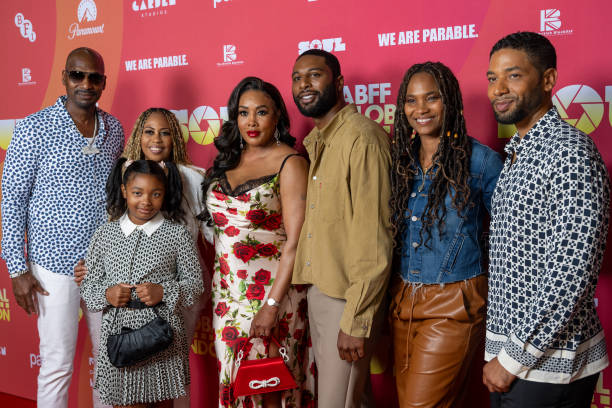
Jussie Smollett’s The Lost Holiday screened at the recent 2024 S.O.U.L Fest Film Festival x ABFF Global London at the BFI.
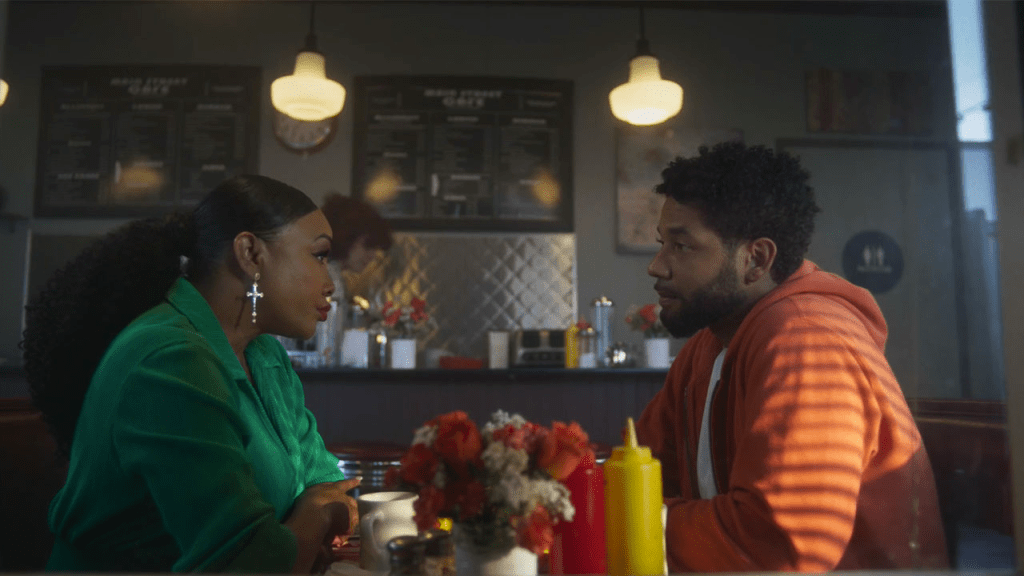
It is a film about a mother who loses her son and discovers that he had a husband and an adopted daughter. The film which took eight years to make was inspired by the director’s own personal experiences with grief and his observations of the struggles faced by queer/queer black individuals. Smollett stars alongside Vivica A. Fox. (Main image credit: Joy @alt_africa_ )
Talking to ALT’s Founding editor and entertainment Journalist Joy Coker, the director/actor/producer discusses the challenges of directing and acting simultaneously and highlights the importance of representation and unity within the black community. Smollett gushes about wanting to work with brits Michaela Coel and Julie Andrews and how great an actor Janet Jackson is, and how he is looking into how to find a way of working with his friend Taraji P. Henson again in future projects.
The American actor and singer began his career as a child actor in 1991 debuting in The Mighty Ducks. From 2015 to 2019, Smollett portrayed musician Jamal Lyon in the Fox drama series Empire, some of the episodes he directed.


JS:
I swear I wasn’t late. I’ve been here.
ALT A:
Good morning, Jussie. How are you?
JS:
How did we miss each other the other night?
ALT A: That’s absolutely fine. But we’re here now. So first I’m going to say thank you so much for talking to ALT A Review and welcome to London.
JS: Thank you so much, so happy to talk to you.
ALT A:
Firstly, can I ask you a bit about The Lost Holiday and what is the premise, for somebody who doesn’t know the story?
JS:
Yeah, The Lost Holiday, it’s about a mother played by the great Vivica A. Fox (Cassandra). Her son is killed in a tragic way right before the US holiday starts, and she goes to Los Angeles. She’s been estranged from him for almost a decade. She goes to Los Angeles to handle his arrangements and sees that they’re already being handled by her son’s husband who she knew nothing about. I play (Jason) the son’s husband, her son is played by Jabari Redd, we have an adopted daughter, and through her son’s husband and daughter and friends, she really learns more about him in death than she knew about him in life.
ALT A:
The film was eight years in the making. Can you give us some kind of insight as to why?

JS:
I am really just started to talk about this, I don’t think anybody really people knew. It’s been almost a decade that my father passed away, the very same day that Empire ever aired on television. And so when the world kind of got to know me, I was dealing with this certain level of grief that I didn’t really know what to do with. And grief is such a confusing thing because one minute you’re sad, and then the next minute you might have some successes in life or some joys in life and you’re happy. And then the next minute you’re feeling guilty about being happy. The next minute you’re feeling guilty about not being happy or resenting your own success. Who knows? Grief just goes in such waves in that way, and I just didn’t know what to do. I felt guilty for being so sad, but I couldn’t do anything about it.
So I really tried to start channeling that into something. And somehow this story came up. I was at my friend’s Christmas party one day and I was just started thinking about all of the things that my mom had gone through being a black woman, marrying a non-black man, and the things that she went through with certain family members of his. And when he passed away, they had divorced a decade or so before he passed away, but now I see that she’s very close to his mom, my grandmother, it just reminded me they are absolutely based on Cassandra and Jason, my character and Vivica’s character. But then going even further than that, I started to think about the sexuality element of it being a queer black man myself, and thinking about all of my mentors that I’ve talked to that are 50, 55, 60 and older who have either lost a partner and possibly being extracted from that partner’s life, being rejected by their family, not being able to celebrate your partner properly, being extracted from their legacy.
And I see the pain that it caused, and I started just thinking about all of these things. And really that’s where The Lost Holiday came. from. It took me eight years for many reasons. It’s not easy to get a film done, but also I was dealing with my own things personally and publicly, and we got it done three years ago. I called up Vivica and I said, listen, I can’t do this film without you. And she said, I got you. And she never switched up on me, she never changed on me, and I’m just forever grateful. And her and Mona Scott Young, who’s my other producer, my producing partner, and Tressa Smallwood as well as my personal producing partner, Tom Wilson, we just came together and we said, we’re going to do this. We’re going to make it special. And we just wanted to make a film that showed how much more alike we are than not.
ALT A:
Talking about acting and directing, what is it that you like about them both and then how do they help each other in terms of your directing and you as an actor?
JS:
Oh, that is such a good question. Such a good way of putting the question. I’ve been acting since I was four years old, so I’ve been doing it for a minute. But directing has always been where I feel I like to be able to create. I’m a creator. I don’t know that I even call myself one specific thing. I’m a creator. So it kind of was just the natural next step, if you will. And a lot of my directing in the very beginning, I started directing my music videos, of course, out of the love for directing and the love for creating, but also out of sheer necessity of not having anyone else, not having a budget to hire Billy Woodruff or someone like that (laughs), just not having it. And so learning what you learn and knowing what you know and just continuously learning.
And then I was able to start directing multiple episodes of Empire, and that was because I kept pitching my music videos to Lee Daniels and Francie Calvo and Brian Grazer and Dana Walden, and just being like, Hey, and Danny Strong, just like, Hey, can I direct? Can I direct? And finally in season three or four, I believe is when they finally let me direct it. I directed multiple episodes and really honed my craft as a director in that way because I didn’t go to school for this. But I went to school for this and learning so much from Jody Williams, who’s one of the EPS executive producers on this film and is one of the only directors of photography that I’ve ever worked with. I worked with her on my music videos on Empire, on Bboy Blues, which was my first film that I directed, and now The Lost Holiday. So directing the first film that I directed Bboy Blues I was not in. So it wasn’t that it was easy, but it was easier.
It was a little bit less time consuming because listen, I’m going to just roll out of bed. I’m going to throw on my sweats. I’m going to shower, but I’m throwing my sweats on. I’m going to get to work and I’m going to do it. This was a little bit more, because you have to realize that when I’m shooting a music video, I’m not looking at playback when I’m shooting. When I was shooting Empire, we had such a large budget that I was able to, they were great with me because the first episode that I directed, they had me in one scene so that I could really focus on directing the next episode that I directed. They had me in a bunch of scenes, but we had a big budget there obviously. So we were able to have playback and all of that type of stuff.
With this we ain’t have no budget to have no playback. So I had to trust my DP. I had to trust my cast, and most importantly, I had to trust myself with that most of my scenes were done in one take just because we didn’t have the ability to do this over and over and over again, nor did I have the ability to watch myself. So directing and acting, I say I probably have to do, if I’m going to keep directing, which I absolutely will, I’m going to have to do one film off, one film on, because it’s just a lot of work. And I love it because I am just an absolute utter psycho that way. But they both rub really, really well because being able to have a say and create your own work is really special to me. So I’m really grateful to have that opportunity.
ALT A:
Wonderful. And you kind of touched on it a little bit, so you shot the film over 11 days. So what would you say if you could pull out one big joy of doing it over 11 days and one of the biggest challenges,
JS:
One of the biggest challenges is probably that we didn’t have a lot of time to necessarily rehearse on set because things were moving so fast. So, it was almost, in a way, very much so like theatre on film in the sense that we couldn’t do it over and over again. We had to make sure that it was pristine at the moment that we got it. And so everybody had to come extra prepared. There was no time to sit and run lines and learn your lines. Although there were big scenes that we did workshop, like the big argument scene with Vivica and I in the kitchen, we absolutely workshop that for probably a good hour, but that was few and far in between because we just didn’t have it. So yeah, I think that that was probably the most difficult, but also very, very satisfying.
It kind of reminds you it’s fun to play. It’s the exciting thing about being an actor. It’s the exciting thing about being an artist is getting thrown all of this stuff and just having to do it and trust yourself and have the guts to just do it. And everybody just came up with their A game and showed up and showed out and was completely prepared and professional. Vivica says this all the time, that everybody had to check their egos at the door, and we just had a really joyous set. As stressful as it was, trying to get everything done on a low budget and in a certain timeframe, it was very, very satisfying because we got it done.
ALT A:
Congratulations. Thanks. So just two more questions. So obviously it’s a global conversation and it has so many different layers. How do you think the industry has shaped up in terms of representation, being a brown person, being a queer person, do you think we’re going in the right direction? Has there been a lot of progress? What’s your view?
JS:
I think we’re certainly moving forward. I think that the pendulum always has to swing all the way to the left and then all the way to the right and then all the way to the left, and then a little bit less to the right and a little bit less to the left before it finds its way in the center. And for me, all I can do is continue to do the work that I do, and all I can do is continue to shine light, shine the light on stories that I feel are important to tell and represent all of the intersections that I exist in. And hopefully it resonates with other people.
I think that progress sometimes can get confused with performative things and we can start to get excited about the idea or the look of progress. And sometimes that can actually slow the actual progress down. And I hope that we continue to move forward. And I hope that my whole mission is to show particularly the black community, that we are so much alike and that we tend to, there tends to be a kind, we break it down almost as these subsidiaries of our own culture, and I just want that to stop. And that if we are so much more powerful together and if we just see that our struggle, our joy, our pain, all of those things in between, I can identify with you. I know that if I sat down with you and we really spoke heart to heart, I know that we would identify with each other’s lives, but society might tell us that we’re nothing alike. You’re a woman. I’m a man. You know what I mean? It’s all of these things that people tell us should be the reason why we don’t connect, and that’s the reason why we talk at each other. We don’t talk to each other. And if we just start to realize that the number one thing that we are is black.
And we must stick together, I hope that the work that I’ve done in the past and the work that I continue to do will shine a light on how important and how passionate I am about the success and the thrive of my black people. And I don’t mean that in a way that’s divisive against any other culture. I just mean that for me. I’m a black man and I love black people. I love my people. I come from a black woman. And so I was raised in a way to be aware of all that we are and to not only just be aware of all that we are, but to celebrate all that we are. So hopefully, I don’t know if that even answered your question. But I just so believe that, that we’ve got to keep pushing it forward and whoever they are. When I was 19 years old, I wrote in my journal when I lived here in the UK, because I used to live in Battersea, I wrote in my journal, I said, I just want to normalize what it is to be a gay black man. And now that I’m older, I realize that there’s no such thing as normal. But I do think that if we just join together and we realize that we are all fighting the same fight in different ways, but still fighting the same fight,
We’d be much more powerful together. So I hope that that’s what we get aside from being joyful and loving and all of that type of stuff from the films, I really hope that that’s the message that we get.
But you end up creating this totem pole of importance within the community. But you can’t do that. We can’t do that, and we can’t allow for the past to affect who we are now because other people have had their words and their ideas in our ears, in our minds, and we’ve been conditioned to think a certain way. But we got to undo some of that stuff and we can, and we will. And we are.
And at the end of the day also recognizing in which ways that we have it different from each other within the community of me recognizing that as a lighter brown black man, yes, colorism is a very real thing. And it’s not actually the responsibility we are supposed to step up for each other. So, it’s simply not the responsibility of a darker brown skin man to speak on colorism. No, it’s my responsibility.
Because if I have in any way benefited from that ignorance, then I damn sure better step up and say something about it. It’s the same thing with women and men. Women can’t be the ones to simply fight for themselves. It’s just like they can do. But it’s a man’s responsibility as well to step up and say, no, you’re not going to disrespect her. You’re not going to treat her less than. You’re not going to pay her less than. It’s our responsibility to step up because why should you have to fight the fight that attacks you all by yourself? That’s not what it is. We’re a community
And really to realize that the common enemy is simply injustice.
ALT A:
Yes, exactly. We can call it that. We can call it that. Exactly.
JS:
And so whoever is the head of that injustice, that’s who we’re going after. So, I pray for us. I pray for us all the time, I think that we are magic, man. We’re magic. And let’s not split one whole magic into two because it just weakens us. So here we are. Stay strong.
ALT A:
So finally, if you could work with anyone, who would you work with?
JS:
Oh gosh. If I could work with anyone,
JS:
There are a couple of people I keep saying I want to work with Michaela Coel so bad.
I also really, anybody who knows me knows how badly I want to work with Janet Jackson, and I’ve worked with her on music videos, but I would love to direct her. I would love to do a film with her. I think that she is such a wonderful actor and I think that I just love her. I love her, but I also really want to work with Julie Andrews. I’ve loved Julie Andrews since I was a kid. I’m not just saying that because I’m here in the UK either. I love Julie Andrews, but honestly, the person that I really want to work with again, and she’s one of my dearest friends. I really want to work with Taraji again. I really want to find something that is completely off what you guys have seen us as prior I just love her so much and I would love to work with her again. So I’m just trying to find different projects that I could humbly go and present to her and say. But she’s been wonderful. She’s been so supportive. So, I would love to work with her again, along with all of those brilliant, brilliant women that I’ve mentioned before.
ALT A:
Thank you so much for talking to ALT A REVIEW.
The cast includes Vivica A. Fox, Jussie Smollett, Jabari Redd, Marquise Vilsón, Brittany S. Hall, Miriam A. Hyman, Londyn Carter, Memphis Cade, Cynthia Bailey, Corey Knott, Alex “ADIV” Duncan IV, Betty Coleman, Bella Bahhs, Gina Belafonte, and Leslie D. Baker.
The Lost Holiday will be opening in the US on 27th September and that it will be available in the UK in 2025.