

The Time is Always Now
“………. And for me, curating and curating exhibitions is a way to hold space, is a way to gather together images and inspiration and create a space where we can have a shared conversation about culture, about society, about who we are…” EKOW ESHUN
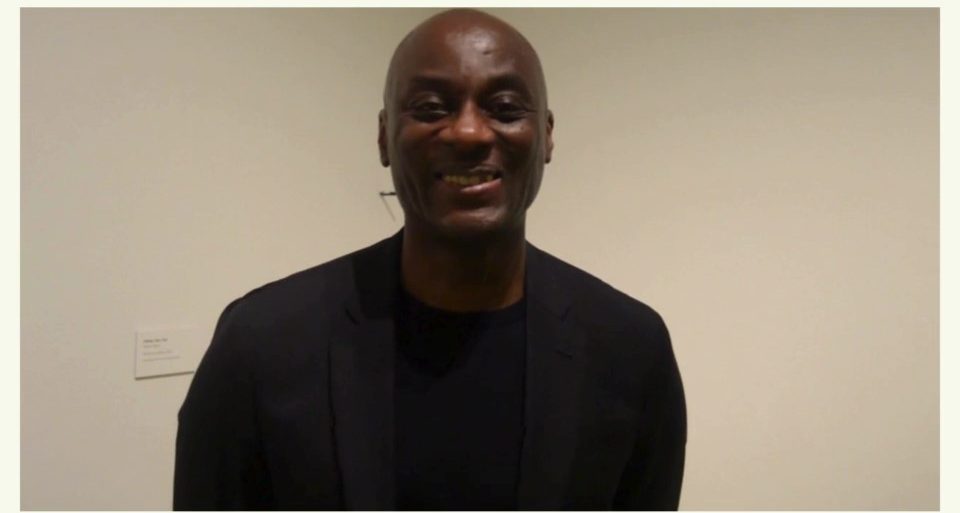
Ekow Eshun is a prominent figure in British culture, renowned as a writer, journalist, broadcaster, and curator.
Eshun’s journey to prominence has been marked by many ground-breaking achievements. Making history as the first Black Editor of a major UK magazine, Arena Magazine, in 1997, he became the first Black director of a significant arts organization, the Institute of Contemporary Arts in London.

Referred to as a “cultural polymath” by The Guardian, Eshun has been a central figure in British creative culture for many years. His contributions span across various mediums, including authoring books, presenting TV and radio documentaries, curating exhibitions, and moderating high-profile lectures.
One of Eshun’s many notable art achievements “In the Black Fantastic” at London’s Hayward Gallery in July 2022. This exhibition showcased visionary Black artists exploring themes of myth, science fiction, and Afrofuturism. Critically acclaimed, it was hailed as “Spectacular from first to last” by The Observer, with The Evening Standard declaring it “unlikely to be a better show this year.”
He presently serves as the Chairman of the Fourth Plinth Commissioning Group in Trafalgar Square; Eshun oversees one of the world’s most significant public arts programs.
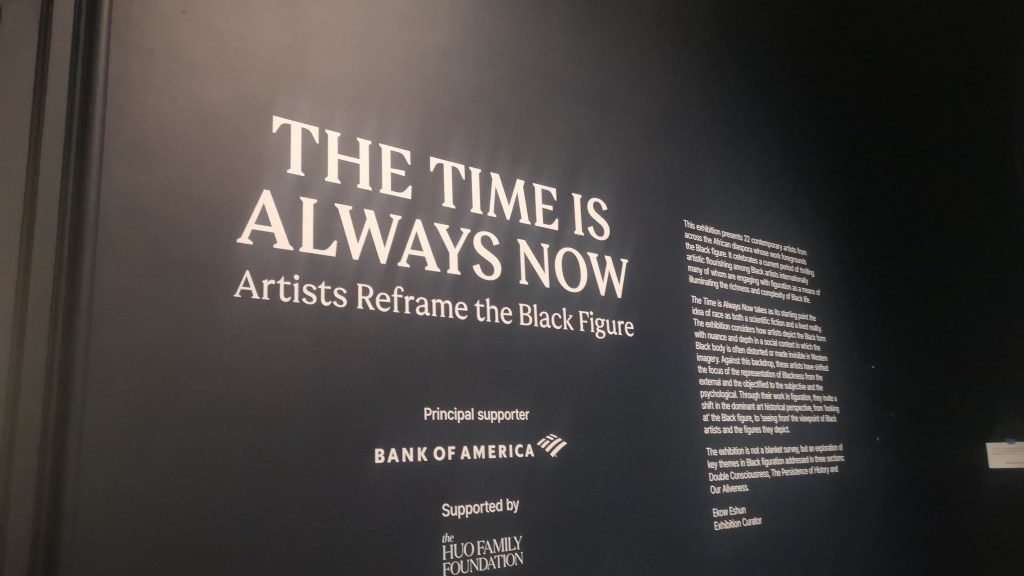
Currently running at the newly opened National Portrait Gallery is his latest curation The Time is Always Now Artists Reframe the Black Figure the exhibition runs until the 19th of May 2024.
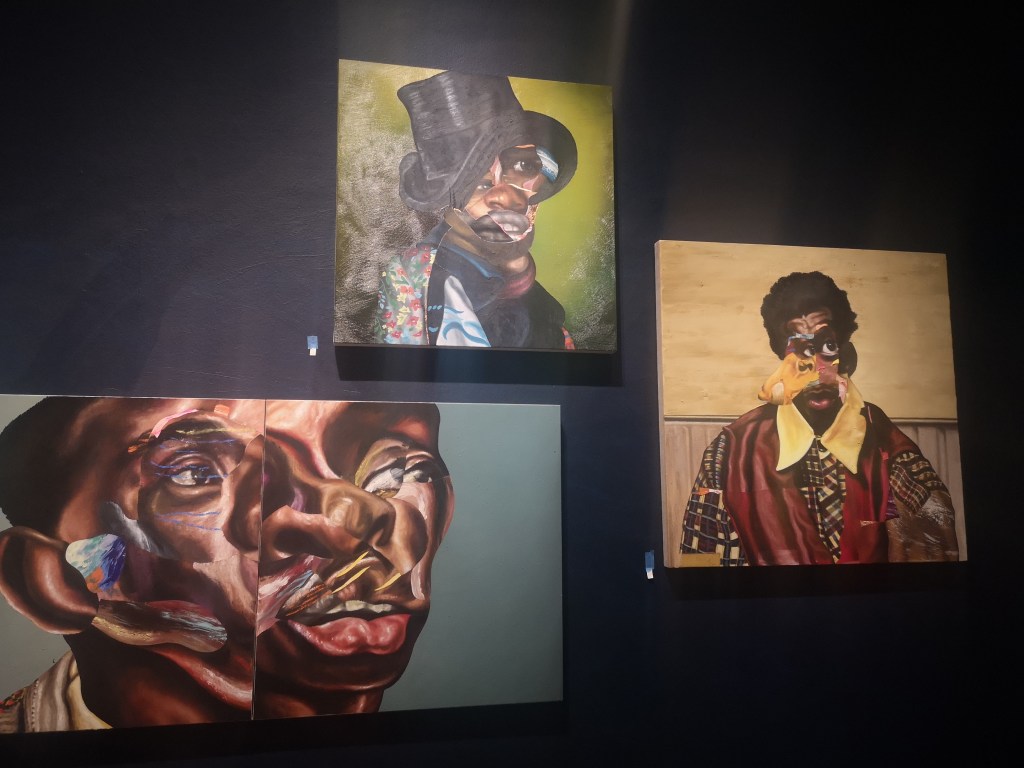
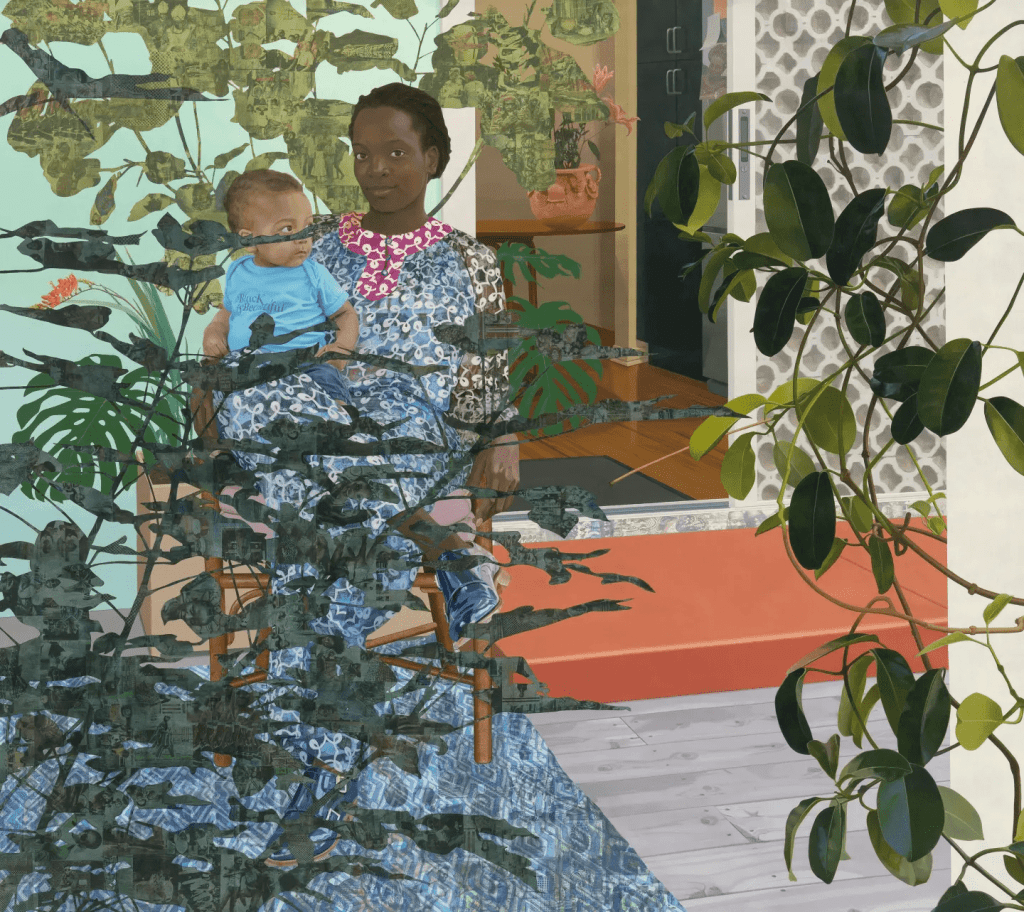
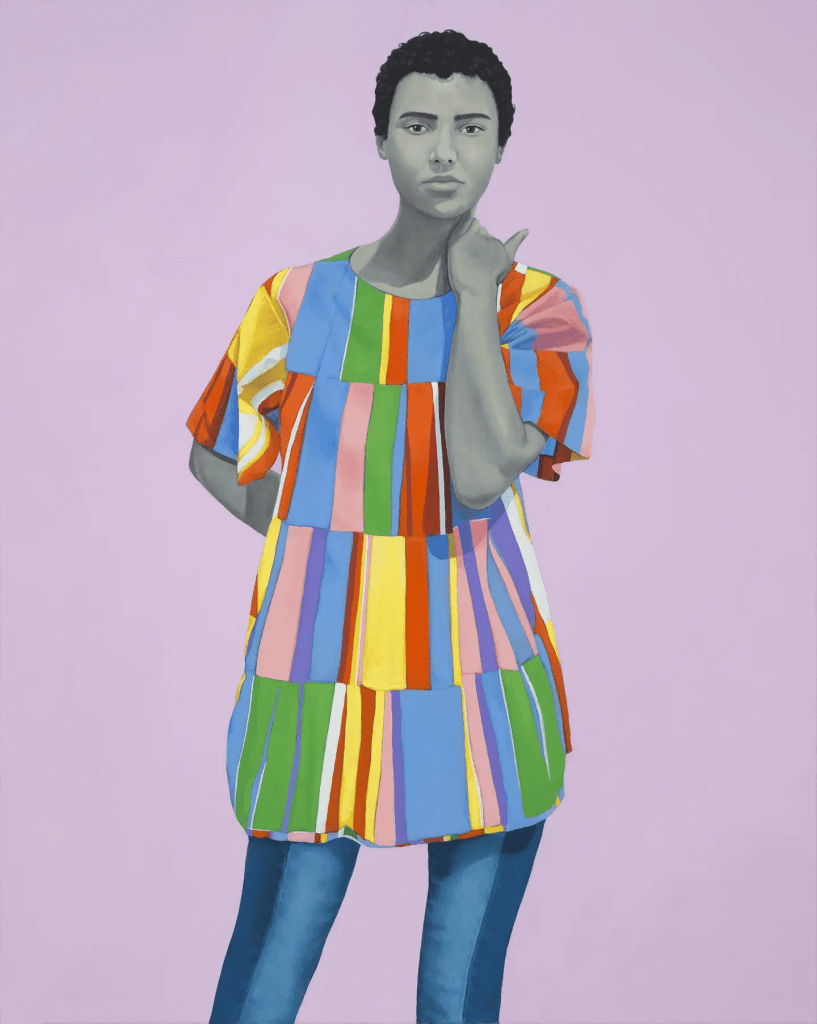
The exhibition showcases the work of contemporary artists from the African diaspora Njideka Akunyili Crosby, Hurvin Anderson, Michael Armitage, Jordan Casteel, Noah Davis, Godfried Donkor, Kimathi Donkor, Denzil Forrester, Lubaina Himid, Claudette Johnson, Titus Kaphar, Kerry James Marshall, Wangechi Mutu, Toyin Ojih Odutola, Chris Ofili, Jennifer Packer, Nathaniel Mary Quinn, Thomas J Price, Amy Sherald, Lorna Simpson, Henry Taylor, and Barbara Walker.
It highlights the use of figures to illuminate the richness and complexity of Black life. As well as surveying the presence of the Black figure in Western art history, it examines its absence – and the story of representation told through these works, as well as the social, psychological, and cultural contexts in which they were produced.

ALT A REVIEW:
How did you find creativity or did creativity find you. How did that love affair start?
EKOW:
I spent years, all my life trying to find a way to make sense of the world that I live in from very early on. From when I was a child, I wanted to be a writer. And I think I did so because I wanted to find a way to speak in my own terms about what it feels like just to be alive, to live in Britain, to live as a Black person in a country where you are in a minority. I wanted to think about both the complexity of that and to try and find a way to make space for myself.
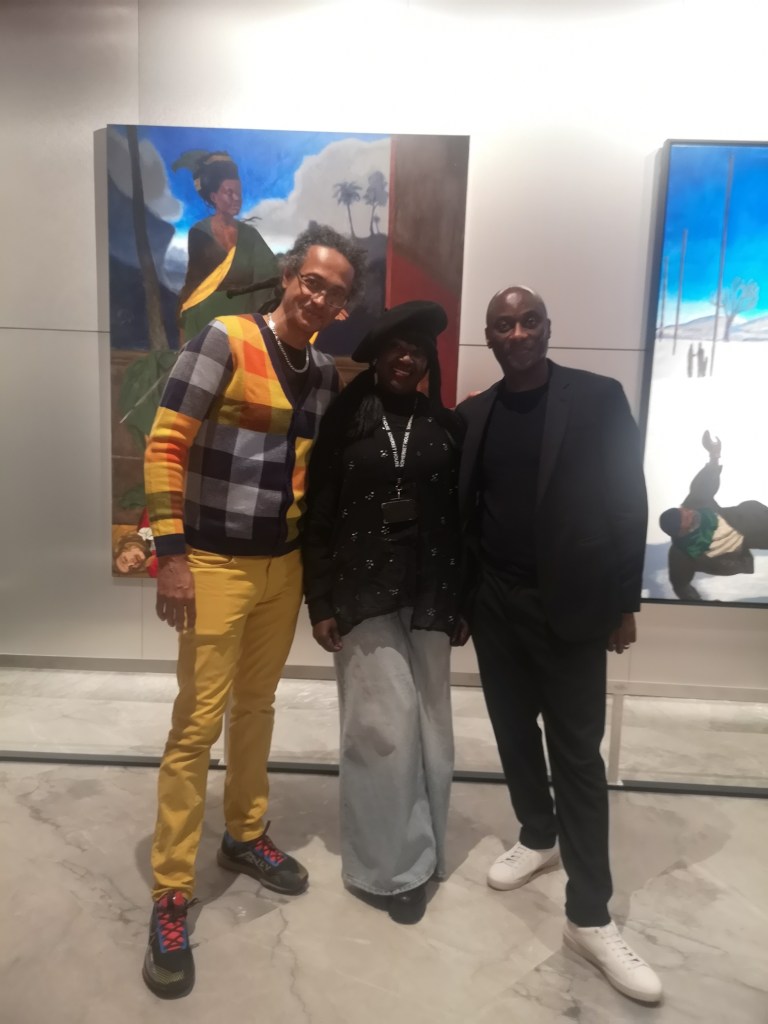
So first, I did that through writing. That’s led to a number of different things, but it’s also led amongst those things to curating. And for me, curating and curating exhibitions is a way to hold space, is a way to gather together images and inspiration and create a space where we can have a shared conversation about culture, about society, about who we are. But it still comes back to the central issues that I was asking myself even from childhood, which is how do I make sense of the world around me?
ALT A REVIEW:
Wonderful. that’s kind of answered a bit of a question I was going to ask you, which was how did you get from editor to curator? I’m just going to quickly ask you, so in moments like being the first black editor of a major magazine like Arena, how did those moments feel for you when you look back on that success?
EKOW:
I’ve been lucky enough to have some single moments in my past. I was the first Black editor of a major magazine to the Arena Magazine, men’s Lifestyle Magazine. I was the first Black director of a major cultural institution, the Institute of Contemporary Arts. Those are significant moments in their own right. Genuinely. I tend to think about them less for themselves and more really what I can try and learn from those and take forward. Actually, right now I spend less time thinking about, oh, I did, or I did that.
I spend more time thinking about, well what more can I do? And that’s not to do per se with ambition. It’s just because it seems to me there’s so much so of a world to explore that you achieve one thing. That can’t be an end in itself. That’s only an aspect. It’s only another moment after that. There’s always more after that. There’s always more to discover after that. There’s always more challenge. So, I tend to think about what I might do next rather than what I have done.
ALT A REVIEW:
Wonderful. And talking about what you might do next and what you’re doing now. So, let’s talk on this exhibition. Can you just talk on the title?
EKOW:
This exhibition is called The Time is Always Now the title is taken from a James Baldwin essay, this essay is talking about civil rights struggle. I wanted to use that title for a couple of reasons really, because my emphasis is chiefly on two aspects in there. It’s on the now and it’s only always in there. We start with the now.
So, the now is about marking what I think is a moment of extraordinary flourishing in visual arts right now where you have Black artists internationally celebrated working at a degree of proficiency and being celebrated to a level, an extent, and a breadth that we’ve never seen in the history of art before this last few decades, this extraordinary period of flourishing. So, I want to mark that moment. That’s the now, but the always in the title, the Always in the Time is Always Now also about saying, let’s not think about this moment as a flash in the pan, as a transitory moment.
Let’s not think about this as a now that comes in and goes, let’s think about this as an always to, which is to say that there’s always been a conversation within culture amongst Black people themselves about who are we?
How do we live, how do we travel through the world? This has been a conversation that artists have taken, that writers have taken, but we haven’t seen this necessarily within the mainstream because for instance, across time, across the last number of centuries, even most depictions of the black figure, for instance, have been in the hands of European artists, western artists, white artists.

It’s really a chiefly in the 20th century that you start to see that shift. So always in the title, it’s about saying, well look, we’ve always been invested in an exploration of who we are. We’ve always been having a conversation about our role and our presence in culture and society.
So, let’s not think about the now simply as something that’s come up out of nowhere and that therefore might vanish into nowhere. Let’s think about this as an ongoing conversation. As a conversation that’s formed out of a lattice of connections and inspirations back through art history, back through culture that speaks of Black presence in the same ways that Black people who have always been part of culture and society. Even has at different times they may have been marginalized, they may have been overlooked, they may have been misrepresented.
ALT A REVIEW:
And how important is art in the social political space and in terms of playing into the conversations in terms of now?
EKOW:
I mean, look, I think art’s a really, really important part of culture and society. And it is so for a number of reasons. One, because it’s an opportunity to create and celebrate beauty that’s important. But more than that, especially in the context of an exhibition like this, this is also a recognition of the role that artists can play in holding complex positions.
At the same time, all of these artworks gathered in this show, they’re all individual artworks that come from different perspectives, from different artists, but they’re all invested in, and they’re all different articulations of the complexity of black being, of black presence of black personhood.
One painting can hold beauty, can hold joy, can hold fraughtness, can hold pain and hurt. And artists are really good at being able to hold these complex and sometimes contradictory positions and doing so without words. Artists are really important because they allow us to look, to think, to imagine, and to feel. And they allow us to do this without telling us how to or what to, they invite us to hold space and to explore the world around us.
ALT A REVIEW:
Do you think artists should be afraid of AI or do you welcome it?
EKOW:
I think when it comes to a subject like AI, individual artists will have their individual position. I think it’s less about being for or against. I tend to think that the significant thing really for any creative person, I think is to hold fast to how you see the world. There’s only a certain amount that we can control around us, but what we do have is our individual voice. We do have is the capacity in one form or another to make ourselves heard.
I think artists will continue to do that even as the circumstances around them may change. Even as AI may shift some of the conversation around what is possible visually, I think the strength and the singularity of an artistic vision will still remain.
ALT A REVIEW:
In terms of Black artist and we’re here at the National Portrait Gallery. In terms of this industry, the art industry, how far do you think we are and being here, what does that speak to?
EKOW:
We have this exhibition here at the time, as always, now we have this exhibition in the hallowed halls of the National Portrait Gallery. It’s one of the central single institutions of British culture and society. It’s a great moment in that respect. But these artists, the artists gathered here already, great artists. These artists are already working at an extraordinary degree. These artists are already celebrated around the world. Many of these artists have solo shows that are traveling internationally. These artists, in pure monetary terms, they’re paintings and their art works are sold for millions at a time.
The show partly recognizes their status and their success, and it’s also an invitation for institutions like the National Portrait Gallery to mark these moments. And actually, just to try and catch up in a way with these shifts and currents. One of the things that’s happened in the last couple of decades is that the role and the significance and the visibility of Black artists has gained, really come increasing prominence over that period. So, the show is another indication really, of the ways that Black artists are being seen.
ALT A REVIEW:
How did you pick artists for this exhibition?
EKOW:
There are 22 artists in the show. I started working on the show five years ago, and I started that with a list of artists. Most of them are in this exhibition right now. Many of these artists, it’s not difficult to make a list because these are world leading artists, Henry Taylor, Chris Ofili, Noah Davis, on and on, but as well as starting to make an introductory list.
The question as a curator, as a curator of a group show is what can happen and what are the consequences or the implications of gathering together a range of artists in one space together? What happens when you position one painting besides another painting?
How do you make sure that in that process you shine further light on that work rather than potentially diminish it even? The challenge in fact isn’t so much the choice around the list of artists. The challenge really is the choice around the list of artworks and how they can sit together and what happens collectively when they’re gathered together. What do we see as a consequence of that gathering as a consequence of the exhibition itself?
ALT A REVIEW:
And if this is not repetitive, can you maybe talk on some of the works here? What can we expect, the styles, themes?
EKOW:
The show, I hope, is a rich and varied set of perspectives and experiences. The show is structured in fact around three themes that speak to inner subjective experience that speak to our artists reflecting on Black presence and absence in art history, and that speak to black sociality and gathering Black aliveness. We’re in this room right now, for instance, in a space in the exhibition that marks and celebrates black aliveness, black gathering, black presence, black empathy, reaching out, holding a space from one artist to another.
We see these different perspectives on black being, black presence, black interiority, the subjective, the shift that we, or what we might see collectively. These artists have different perspectives, but if they have one thing in common, it’s an invitation to the viewer to not simply look at the black figure, but to look with or through the eyes of the black subject, either within the frame of a pen or through the eyes of the artists themselves. A shift is the shifting gaze looking at to looking with, and you see that refracted in different ways throughout the exhibition.
ALT A REVIEW:
Wonderful. And finally, what’s next for you?
EKOW:
What’s next for me? I have a book. I have a nonfiction book that comes out later this year called The Strangers, which looks through the eyes of a number of different Black men in history from the early 19th century to the present day. Like Malcolm X. And then I have a range of other exhibitions that I’ve curated that open in London, Africa, America. So, I have three or four more shows that I’m working on between now and next summer.
ALT A REVIEW: Why should people visit the newly refurbished NPG to see the Time is Always Now?
EKOW: It’s a show that looks at the depth and richness and the complexity of black being and the black presence. It’s a show for everyone. It’s a show that opens up space that thinks about black life, black being but it’s also a show about beauty, about empathy, about fragility, about desire, about human connection. It’s a show for everyone.
ALT A REVIEW
Thank you so much for talking to ALT A REVIEW.
Where:
National Portrait Gallery
St Martin’s Place
London, WC2H 0HE
+44(0)20 7306 0055
You might also like: Star of stage and screen Brian Cox named as the newest Patron of the Edinburgh Festival Fringe